Bridging the Generation Gap – NGJ Mid-Band Now on Duty
By John Haystead
THE PRINCIPLE TASK of Naval Air Systems Command’s (NAVAIR’s) Airborne Electronic Attack Program Office (PMA-234), might seem, or perhaps was once seen, as a rather straightforward mission: develop and field a new and improved version of the AN/ALQ-99 Tactical Jamming System (TJS) to be known as the Next Generation Jammer (NGJ). This turned out, however, to be very far from a simple task. A constantly changing and evolving threat environment, paired with continuous and rapid technology advancement, and a wide variety of different requirements and available mature solutions for dealing with specific target types, all come together to make the job a complex balancing act between the cost and delivery timeframes of pursuing all-new system technology versus tailored upgrades to existing system elements.
Still on the Job
The challenge of NGJ begins with the venerable AN/ALQ-99 TJS itself. For reference, the ALQ-99 achieved Initial Operational Capability (IOC) in 1971. At the time of the Analysis of Alternatives (AOA) and development of the initial requirements documents for NGJ in 2008, the plan was to develop and field a single-system replacement. That changed, however, in the 2011/2012 timeframe, when the decision was made to split up the requirements, development, and procurement of the system into three increments: Low-, Mid-, and High-Band segments.
The specific frequency ranges addressed in the three segments are classified, but for general reference, unofficial sources have suggested that they are roughly 100 MHz-2 GHz for Low-Band, 2-6 GHz for Mid-Band, and 6-18GHz for High-Band. Similarly, the specific types of communications and radar targets being addressed by each segment are also not officially denoted but, as CAPT David Rueter, Program Manager of PMA 234, phrases it, “We’re looking to affect as many things in the RF spectrum as we can. This includes denying, disrupting or degrading the enemy’s traditional RF-based defense systems, but also ‘to put the fog into the fog of war,’ doing everything we can to affect the adversary’s information flows, from their sensors that are trying to collect information to their communication links trying to share that information.”
As recalled by Rueter, who himself participated in the original NGJ AOA work, “The decision to split the program into increments was basically driven by the state of maturity of the available technology at the time. Mid-Band was chosen to go first because the technology to handle those frequencies was the most mature and ready to be implemented.” Now, however, Rueter says the situation has changed with mature technology becoming much more prolific across the board. “We’re already seeing this on the NGJ Low-Band program, which has only been under contract [for less than a year]. Today, the current state of technology maturity in the low-frequency ranges is also pretty good, but had we initially chosen to pursue Low-Band as the first increment, we wouldn’t be where we are today with the overall effort.” Still, a significant impact of the change was that, although the plan called for the ALQ-99 TJS to eventually be replaced by NGJ on all Growlers, it would now need to remain in service until all increments of NGJ reached full operational capability. As it stands now, that date will depend on the assessed need for, and/or deployment of, NGJ High-Band. Says Rueter, “It’s hard to say exactly when that will be. The ultimate retirement date depends on how long we can keep the high-frequency portions of the ALQ-99 going. It also depends on what the adversary does.”
AN/ALQ-249 NGJ Mid-Band (NGJ-MB)
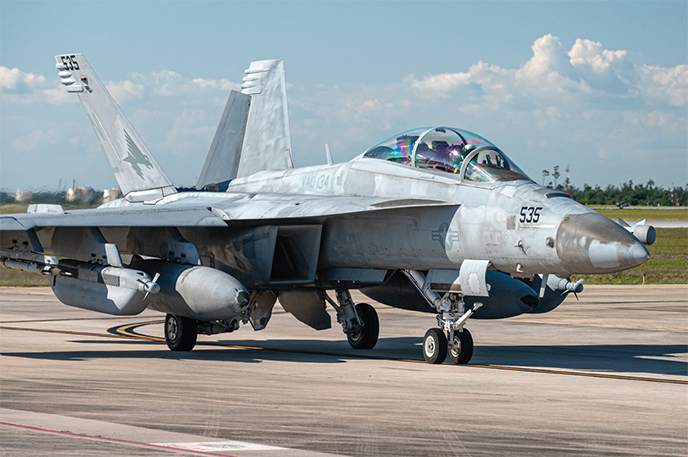
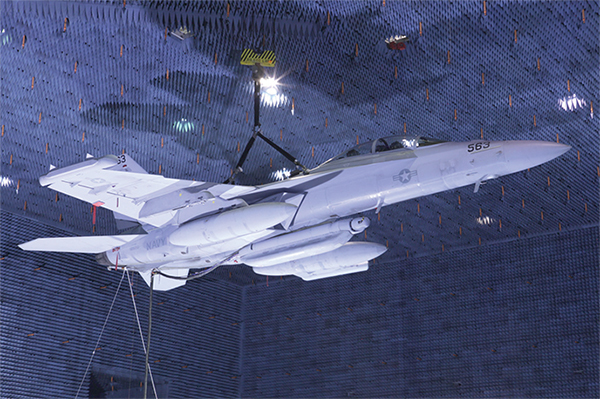
The first NGJ increment out of the block is the “AN/ALQ-249” NGJ-MB system, which achieved IOC in December 2024. A Joint cooperative program between the US and Australia, the ALQ-249 system is designed to engage multiple advanced threats at greater standoff ranges than the ALQ-99, including communications, datalinks and non-traditional RF targets, by employing both reactive and preemptive jamming techniques. The system consists of two pods containing Active Electronically Scanned Arrays (AESAs). Though a two-pod configuration, Rueter says, “It truly functions as one system. You actually could operate with a single pod, although you’d lose some amount of capability.”
Onboard the Growler, the ALQ-249 is completely integrated with the ALQ-99, along with the Northrop Grumman AN/ALQ-218 mission receiver system (carried in the aircraft wing tips) as part of the aircraft’s overall AEA suite. This is unlike the arrangement with the ALQ-99 system, when the ALQ-218 was independently deployed on EA-6B Prowler aircraft. In the Growler architecture, all of the systems come together and are presented to the operator as one suite of systems. Says Rueter, “When we designed the NGJ-MB, we just made it another TJS element, so to an operator managing a mix of ALQ-249 and ALQ-99 pods, it’s transparent when making decisions as to which jamming assignments are tasked to which system.”

Importantly, however, the ALQ-99 and ALQ-249 are different in terms of their operational flexibility and capabilities. “We refer to the ALQ-99 system as a missionized system, meaning there isn’t just one single ALQ-99 pod,” says Rueter. At the time of that system’s development, different hardware was required to handle different portions of the frequency spectrum, so there are different Weapons Replaceable Assemblies (WRAs) used to build out the pods. Growler squadrons are outfitted with some number of these WRAs, which the aircrew select for use on each mission. Maintenance personnel will then configure each pod as directed. There are low-, mid-, and high-band WRA transmitters which together allow the ALQ-99 to cover the full operational frequency range.
In contrast, the NGJ is fundamentally different. As explained by Rueter, “The fleet doesn’t like missionized systems because if you have a plan and you upload it, but something changes, you actually have to land and have some maintenance action to reconfigure the system.” Because of this, one of the major driving requirements and design criteria for NGJ-MB was that it be able to cover the entire mid-band frequency spectrum with the same hardware. The ALQ-249 uses the latest digital and software-based technologies to address advanced and emerging threats on the fly.
As emphasized by Rueter, “We try to have hardware that is as flexible as possible, because the fastest way to do an upgrade is through software.” Rueter points out that a key element of this is the Jammer Technique Optimization (JATO) organization, a major element of PMA-234’s Advanced Development (ADEV) Integrated Product Team. JATO focuses on the development of the most optimal jamming algorithms and techniques, as well as up-to-date tactics, techniques and procedures for operational use.
Following a Milestone C production decision in 2021, the NGJ-MB program began Low Rate Initial Production (LRIP) that same year with a contract for three shipsets (6 pods). This was followed by a Lot II contract for five shipsets in FY2022. The next year proved to be a significant year for the program, with the delivery of those first three shipsets and a Lot III contract for 15 shipsets (30 pods), including four shipsets ordered by the RAAF. A Lot IV contract for 13 shipsets (26 pods) was awarded in November of 2024, including another four shipsets for the RAAF. In May, the Navy awarded a $580.6 million contract for Lot V production contract which included an undisclosed number of shipsets for the US Navy and the RAAF. According to FY2024 budget documents, the Navy planned to acquire 10 shipsets (20 pods) for its Growler fleet under this contract. The Navy plans to buy up to 129 NGJ-MB shipsets in total.

NGJ Low-Band
Next up for NGJ will be the Low-Band variant (NGJ-LB). Also a Joint effort with the RAAF, L3Harris was awarded a $587.4 million contract in August of 2024 for the Engineering and Manufacturing Development (EMD) phase of the program. The contract supports the final design efforts and manufacturing of operational prototype pods (scheduled for delivery in late FY2025) and system-level prototypes (to be delivered in FY2026), including two aeromechanical test pods and two mission system test pods, as well as aircraft integration work.
NGJ-LB is expected to counter a larger number and variety of adversary systems in the lower-frequency range than the current ALQ-99 system. It’s currently scheduled to reach IOC in 2029.

Operational Complement
Growler aircraft have multiple hard points, five of which are capable of carrying a mix of ALQ-249 or ALQ-99 pods, external fuel tanks (EFTs), and in future, the NGJ-LB pod. Currently, the operational AEA mission complement of the Growler is a combination of the ALQ-249 Mid-Band and the ALQ-99 high- and low-band jamming pods. Rueter says one of the big questions going into the ALQ-249’s first deployment in November of 2024 with Electronic Attack Squadron, VAQ-133 “Wizards” aboard the USS Abraham Lincoln Carrier Strike Group, was how exactly it was going to be operated. The answer was, “It varied. There were some flights that were NGJ-MB only, there were some flights that were a mix of NGJ-MB and ALQ-99 pods, and there were some flights that were ALQ-99 only. So they were reconfiguring based on what they needed to do for each mission. That’s how they’re working together today, and I would expect that once Low-Band is flying, it will interface the same way, where you may be flying with a mix of ALQ-99, ALQ-249, and Low-Band pods, because that’s what the mission dictated, and they would work seamlessly together as well.”
NGJ High-Band
And then there is NGJ High-Band (NGJ-HB) program. The requirements for NGJ-HB were actually defined in the initial overall NGJ requirements document, so as Rueter says, “We do have a general idea of what High-Band should be. But then again, those requirements were written 15 years ago; so where is the threat today, and what things do we need to effect in that high-frequency space? Can we get it done with the ALQ-99 today or do we need something new?” Rueter says they’re in constant conversation with the resource sponsor, OPNAV, on just that question. “Today, we’re at the point of trying to determine the right time to fund an NGJ-HB effort and make it a program, but we’re not there yet. We’ll wait and see how NGJ-MB is used and how it evolves, and what the threat does.”

Not Done Yet
As was discussed at the outset of this article, the challenges in fielding a system with the technical complexity of NGJ together with its wide and constantly-evolving mission, are many and difficult to solve. It can’t be done overnight. Add to this the need to make important decisions to ensure that critical capabilities needed now are made available as quickly and as cost-effectively as possible – even if they don’t provide for a permanent solution. The continuously arising question is what is the best pathway to accomplish this?
As observed by Rueter, “Something that I’ve learned over my career is that the rate of change of the adversary and the systems we’re trying to target has greatly increased over the decades. Our challenge here at PMA-234 is to build these systems that are adaptable and upgradeable just as fast as our adversaries are upgrading their capabilities in sensors and communications.” As is clearly evident with NGJ, there are multiple ways to approach this – one of which is evaluating the tradeoffs of upgrading an existing, if legacy, system such as the ALQ-99 – a process that has been going on continuously since its introduction. Another is continuing to expand or upgrade the capabilities of newly-introduced systems such as NGJ Mid-Band, or perhaps develop other new quick-fix solutions as interim measures until the full-featured, long-term solution is available.
Low-Band Consolidation (LBC) Transmitter
Rueter acknowledges that deciding on the best solution pathway isn’t always easy. Referencing the current timeline of the NGJ-LB program, he notes that, “We’re in that phase of the program where we also need to look at possible temporary fixes through the ALQ-99.” Rueter says they’re doing this based on a business-case-analysis approach. “What will it cost to make this upgrade? How long will that system be fielded before it is replaced by NGJ-LB?”
Already aware that there was an obsolescence/sustainment problem in the lower frequencies of the ALQ-99, the program office found itself facing a source-selection protest for the NGJ Low-Band EMD contract. “We couldn’t predict when that would be resolved, and it was really this not knowing for certain when NGJ Low-Band would be available that lead us to pursue the [ALQ-99] Low-Band Consolidation (LBC) transmitter effort.”

In November 2024, the Navy awarded Honeywell (formerly Cobham Advanced Electronics Solutions – CAES) $29.9 million for six 6 LBC modifications for US Navy and 16 LBC modifications for Australian ALQ-99 systems, replacing its existing TWT-based transmitters with Gallium Nitride (GaN) technology-based units. The contract also calls for an improved universal exciter upgrade with Application Specific Integrated Circuits (ASICs) to address obsolescence/sustainment issues.
LBC was originally a development program conducted back in the 2015/2016 timeframe with CAES that was in fact taken all the way through to the point that it was ready for production. At the time, however, the Navt decided not to move forward with production because it believed that by the time the transmitters were ready, NGJ Low-band would be available. With the change in circumstances, however, the program office was able to take it off the shelf and put it into production immediately. OPNAV approved a limited production run of LBC transmitters with the final number to be determined upon further evaluation of the state of NGJ Low-Band. As stated by Rueter, “Now that we’ve been on contract with NGJ Low-Band since August of last year, we’re working with the prime contractor, L3Harris, to really assess their level of maturity and when NGJ Low-Band will realistically be ready for production. We’re working hard to get this capability to the warfighter as soon as possible.”
Mid-Band Expansion (MBX)
At the same time that the program office is looking at upgrades to the ALQ-99, it’s also already looking at increasing the capabilities of NGJ-MB through Engineering Change Proposals (ECPs) – another option to pacing the threat in the most expedient way. The fact that NGJ systems are now solidly based on modular open-systems architectures allows for the efficient implementation of these ECPs.
In October 2024, the Navy awarded Raytheon a $192 million contract for the NGJ Mid-Band Expansion (NGJ-MBX) effort. The modification includes upgrades to both software and hardware to extend the frequency range of NGJ-MB into the high-band range to address evolving threats, as well as provide additional capabilities to improve operational effectiveness. The Navy determined this approach was the quickest way to meet such near-term threats prior to any NGJ-HB effort.

According to the Navy’s FY2025 budget request, the MBX effort will focus on developing a new Advanced Frequency Converter Module (AFCM) and an MBX Array. This will include Raytheon delivering prototypes of 12 MBX arrays and 36 AFCMs to support Critical Design Review, as well as EA-18G software integration work performed by Boeing. MBX testing will begin in FY2026 and run through FY2028.
Rueter says MBX actually involves “a little bit more work than a simple ECP. What we’re trying to do will require a little bit more engineering. It won’t be a simple modular swap of hardware components. What we’re trying to do is make the hardware and software as open and as modular as possible in order to pace the threat.” It’s likely that the performance of NGJ-MBX will have an impact on the timeline of NGJ High-Band work.
Challenges Remain
As the NGJ program has progressed, some challenges have indeed now been addressed. But, others still remain, not the least of which is accomplishing the full retirement of the ALQ-99 system and the removal of its associated weaknesses and shortcomings. For example, although the AN/ALQ-249 is fully mission-reconfigurable in flight, the ALQ-99 pods are still not. That obviously means there is a good chance that Growler missions will still sometimes have to be cancelled or delayed in order to reconfigure them for a changing mission profile or threat environment.
Rueter acknowledges the problem. “Yes, the scenario you described is a potential. Until we get all NGJ increments fielded, we will be operating at least some ALQ-99 pods. We’re constantly evaluating how to better meet the fleet’s AEA needs.”

It may not actually be an issue, but one might also wonder if the ability of the Growler to only carry a maximum of five combined AEA pods might be a concern, particularly for a mission where it was necessary to cover the full frequency range and where there would also be a need to carry two external fuel tanks which share the same hardpoints. In that case, NGJ-MB would take up two of the remaining three hardpoints, leaving only one additional spot for either an ALQ-99 high- or ALQ-99 low-band pod, or a future NGJ-LB pod. As Rueter says, “you (only) get five stations for whatever combo you like.”
With the passage of time, and the continually evolving threat environment, it may already not be too early to start thinking about AEA capabilities on a different next-generation aircraft platform or unmanned system, or both. But, as Rueter emphasizes, “Those decisions are really more for the platform offices. What we focus on here is being the AEA provider. So, if a fifth-gen platform – or any other platform – is interested in AEA, we want to have a range of solutions to offer. It could even be for something as small as a quadcopter, that it is looking for some level of EA capability. The nice thing about the ALQ-249, is that it’s already developed, so that if someone walks in and says they want to have that capability, we can just say, ‘Great, here’s your pod. If you can hang it, you can have it tomorrow.’ Of course, if they have a particular size, weight, or power constraint, we’ll have to sort of go to the drawing board, but we’ll then figure out what of our modular systems can we piece together to meet their needs.”