AOC and Its Chapters Foster the Future Through Scholarships
The following article was published in the April 2024 issue of the Journal of Electromagnetic Dominance (JED) as part of the AOC’s 60th anniversary celebration.
By Wayne Shaw with contributions from Lisa Frugé-Cirilli, Bob Simmen, Paul Westcott and Glorianne O’Neilin
AOC began as an effort to preserve vital electromagnetic warfare (EW) knowledge. The early leaders of AOC recognized that they needed to foster the next generation of EW talent. Filling this need started with chapters. The Kittyhawk Chapter in Dayton, OH, established the very first AOC scholarship program in the 1968 with AOC Headquarters eventually following suit.
This wasn’t easy! It required chapters to establish a separate 501(c)(3) part of their chapter with a separate bank account. At the national level, the AOC Educational Foundation was established in 1985. A separate and distinct Board of Governors was established to provide oversight of the AEF. Funds can flow from the 501(c)(6) part of the AOC to the AEF, but not in the other direction. So, there are several rules that HQ and chapters must follow to enable the scholarship program. The AEF articles of incorporation were amended in 2011 and since then the AEF has been a significant part of each face-to-face gathering of its Board of Governors – many, but not all of whom, are also on the AOC Board of Directors. The AEF’s Board of Governors is striving to make the AEF financially self-sufficient.
Chapter Scholarship Programs
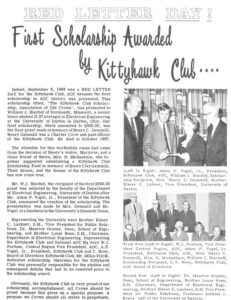
The Kittyhawk Chapter led the way introducing its scholarship program in the early 1970s. Currently, the Kittyhawk Chapter awards between $10,000 and $12,000 in scholarships annually. The chapter has scholarship programs with Wright State University, Sinclair College, the University of Dayton, Cedarville University, and Ohio State University. Since that time, it has awarded approximately $500,000 in scholarships.
Competition between the chapters has long been an ingredient of the AOC’s “secret sauce.” Not to be outdone by the Kittyhawk Chapter, the Dixie Crow Chapter established its own scholarship program in 1979 and since then has awarded approximately $1,366,000 in scholarship funds. The Dixie Crow Chapter has a $52,600 annual Educational Foundation Budget, which helps explain the $1.37M total figure. In addition to these scholarships, the Dixie Crow Chapter also contributes $5,000 each year to the Georgia Museum of Aviation, where the annual Dixie Crow Symposium is held. The proceeds from the Dixie Crow Symposium in turn are a key ingredient in the ability of the Dixie Crow Chapter to have such a well-funded scholarship program.
The Windy City Chapter started their scholarship program in 1983 and has thus far provided $400,000 in scholarships to 180 deserving students. In the Golden Gate Chapter’s “salad years” of the 1970s to the 1990s, they estimate that they gave out between $12,000 to $15,000 in scholarship funds to a dozen scholars. As is typical of most AOC chapters’ scholarship requirements, the recipients must have an expressed interest in defense electronics or US government service. Also, a one-year AOC membership accompanied a scholarship from the Golden Gate Chapter.
Unfortunately, there isn’t room to discuss every one of the chapters that support a scholarship program. All told, AOC chapters give out about $175,000 in scholarships each and every year to approximately 100 recipients.
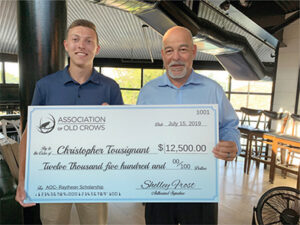
At the national level, the AOC Foundation currently awards $25,000 per year through the STEM Student of the Year Scholarship, generosity supported RTX.
Editor’s Note: In 2025, the AOC Foundation, with support from Rohde & Schwarz, started the From Service to Scholar Scholarship Program, which awards $2,000 scholarships to up to five veterans. The funds are meant to fill the gap that exist between the GI Bill and the true cost of higher education.
Impact on the Future
But to what end you ask? We take it on faith that awarding scholarships to students pursuing advanced education is “goodness,” but have all these funds awarded over the last 60 years made an impact on our profession? Has this helped ensure a continued EMSO workforce?
With multiple chapters and the headquarters itself awarding scholarships using different criteria, of different amounts, it’s difficult to assess the “dependent variable” when there are multiple and different “independent variables,” but there are compelling anecdotal stories of students who have entered the EMSO workforce thanks in part to AOC scholarships received. For example, a Dixie Crows scholarship recipient, Andrew Ollikainen, now works for Northrop Grumman. So, the AOC scholarship program is helping to maintain the EMSO workforce that is so important to our collective national security, both in the US and its allies and security partners.