Advocacy in Action: How the AOC Brought EW to the Forefront of Congressional Priorities
The following article was published in the June 2024 issue of the Journal of Electromagnetic Dominance (JED) as part of the AOC’s 60th anniversary celebration.
By Wayne Shaw with contributions from Ken Mathiasmeier
The 1990s started with a “bang” with Operation Desert Storm in the early morning hours of January 17, 1991. The exquisitely planned air war took out Iraqi air defenses and allowed coalition ground forces to move into and through Iraq to expel Iraqi forces from Kuwait in record time. By the end of February 1991, the war was essentially over, faster than many of the most knowledgeable planners had imagined. Electromagnetic warfare (EW) was an essential element. By one authoritative estimate, “without electronic countermeasures, fully 50% of all strike aircraft would not have returned.”1
“First blood” was drawn by Task Force Normandy: three US Air Force (USAF) MH-53J Pave Low helicopters pathfinding the way for nine US Army AH-64 Apaches, which took out two Iraqi “Tall King” radars in the opening minutes to form a narrow corridor for other coalition aircraft to flow through. Mainstream EW activities were performed by coalition EW aircraft, such as USAF EF-111s and US Navy (USN) EA-6Bs jamming Iraqi air defense radars, with the EA-6Bs also unleashing AGM-88 HARMs against the Iraqi air defense radars. USAF F-4G Wild Weasels used that same munition in a more precise way to provide suppression of surface-to-air missiles (SAMs) to enable coalition airstrikes. One F-4G and its crew dodged five SA-2s while hunting down and destroying its controlling Fan Song radar. One EF-111 was engaged by an Iraqi Mirage F-1 and the Raven crew had to slice left descending from their 1,000-foot altitude, then had to break right, descend to 400 feet while dispensing chaff for a missile launched by the F-1. Thanks to an assist from an F-15C, they witnessed the Iraqi F-1 explode against the desert floor.2
USAF RC-135V/W Rivet Joint and USN EP-3E Aries II crews provided real-time SIGINT, jamming refinement and “TACREPs,” while Royal Air Force Nimrods kept an electronic eye on the Persian Gulf and helped enforce the embargo against Iraq. NATO E-3 AWACS provided “picture” calls to strike packages flowing in through northern Iraq. The USAF EC-130H Compass Call jammed Iraqi communications and its specialty, command and control between Iraqi ground-control intercept controllers and Iraqi airborne fighters. Other classic EW tactics were used: “BQM-74 Scathe Mean Drones, which flew missions in loose formations to simulate inbound bombers attacking Basra and Baghdad during the initial stages of the aerial campaign.”3 Many adversary nations studied the coalition’s success and started making significant investments in their militaries to include EW, cyber, and other EMSO-related capabilities. Today we are faced with the fruits of those investments, which demand a new round of investments by member nations of the Association of Old Crows (AOC).
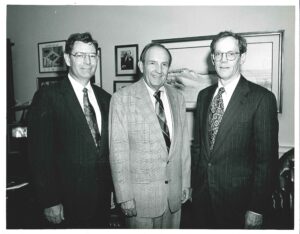
In the dynamic landscape of EW advocacy and strategic planning during the 1990s, the AOC played a pivotal role, particularly through its initiatives such as the Capitol Hill Roundup and the establishment of the Senior Advisory Board. The Capitol Hill Roundup, initiated in 1990 under the leadership of RADM (Ret.) Julian Lake, AOC President (1990-91), was a concerted effort to educate US Congress on the fundamental principles of EW and the necessity for funding this critical domain. Spearheaded by US Congressman Earl Hutto from Florida’s 1st District, the Roundup convened approximately 50 AOC members annually with their respective congressional representatives. These meetings focused strictly on educational discourse, adhering to guidelines prohibiting any form of company advertising. The presence of constituents was mandated, ensuring a grassroots connection in every interaction. Handout materials were permissible, facilitating the dissemination of pertinent information beyond the confines of the meetings. In 1999, Congressional members, led by Representative Joe Pitts, established the EW Working Group that continues today.
The AOC also recognized the need for broader strategic insight from experienced military and civilian leaders, leading to the inception of the Senior Advisory Board during Ken Mathiasmeier’s AOC Presidency (1998-99). Comprising luminaries like Dr. Paul Kaminski (Chairman), and Admiral William Owens, the board convened two to three times a year and provided guidance and recommendations for the AOC’s strategic planning. Drawing from their wealth of experience, the board’s insights were invaluable in shaping the AOC’s long-term trajectory.
Both initiatives were instrumental in advancing the AOC’s mission during the 1990s. The Capitol Hill Roundup fostered direct engagement with policymakers, ensuring that the significance of EW was comprehensively understood within Congress. The Senior Advisory Board enriched the AOC’s strategic outlook, leveraging the wisdom of seasoned leaders to navigate the complexities of an evolving EW landscape.
As evidenced by these endeavors, the AOC played a vital role in shaping the organization’s advocacy efforts and strategic direction during a transformative decade in EW history.
1 Hallion, Richard P., Storm Over Iraq: Air Power and the Gulf War, Smithsonian Institution Press, Washington, D.C., 1992, p. 172.
2 History Channel series, Dogfights: The Complete Season Two, Dogfights of Desert Storm, Season 2, Episode 12, Produced by Digital Ranch for The History Channel, A&E Television Network, 2008.
3 Nixon, Phyllis, Deceiving the Enemy: These Are the Drones You Are Looking For, Air Command & Staff College paper, Maxwell Air Force Base, Alabama, 2016, p. 8.