
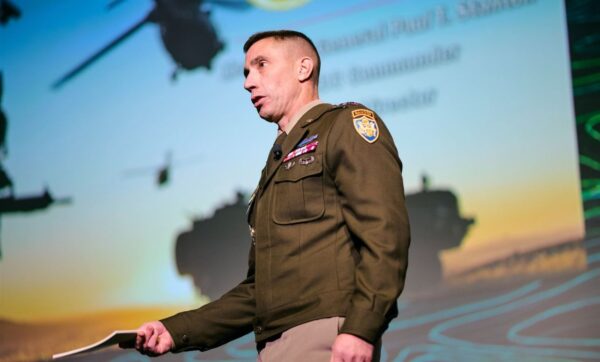


Lieutenant General Paul T. Stanton, Department of War Cyber Defense Command Commander and Director, Defense Information Systems Agency (DISA), delivered last Thursday’s keynote address at AOC 2025, in which he emphasized the importance of EW experts informing warfighters and other leaders to make them smarter about EMSO.
Stanton said those who know the “science” behind EMSO- and cyber-related systems need to find ways to communicate that knowledge to the warfighter. “We that understand the science have an obligation to integrate the science into the execution of maneuver warfare. We have a responsibility to explain the technical depth in terms that the warfighting community can understand. And that’s not just to the ‘39’ or the EMSO chief or the J6; that is to the ‘3’ – into the commander.”
From there, Stanton discussed the nature of ubiquitous EMS sensing and the reality that sensor systems must also transmit their data via the EMS. “The foundation of being able to move data is the electromagnetic spectrum” he said. “Think about all of the insights that are derived from the sensors for which we are responsible. And what makes it incredibly difficult and challenging from our perspective is that we are under constant observation from an enemy that is trying to kill us.”
He continued, “Let that sink in for a second. … Think about the juxtaposition and the irony of creating battlefield awareness in the electromagnetic spectrum by aggregating sensor data and creating a picture that shows us what’s happening in the operating environment, with the requirement to actually move the data. Moving the data, by default, requires transmission. Transmission creates a signature. A signature can be detected. And if you are detected, you’re targeted. And if you’re targeted, you damn sure better move because rounds are inbound. That’s hard. We cannot think about a sensor in isolation. We must think about sensing.”
As a former infantry officer, Stanton’s speech also dove into the need for EMSO-related technologies that meet joint requirements. “Are we thinking about the joint fight?” he asked the audience. “If we’re building capabilities that only speak to a certain service, shame on us. My job as a combat support agency and the director of DISA is to solve an inherently joint problem. That’s what we have; our EMBM-J system [Joint Electromagnetic Battle Management System] that we are developing is purposefully designed to accommodate censored data from across our joint force. If you don’t know what the ports and protocols are in order to speak to EMBM-J, talk to our program manager today and figure that out. Because if you’re designing a system that can’t speak the language of the data aggregation inside of an inherently joint fight, then your system is not interesting. It doesn’t solve the problem.”