
The Invisible Battlespace: Achieving Spectrum Dominance


SPONSORED CONTENT PRESENTED BY ATDI

Dominance of the electromagnetic spectrum is critical in contested environments. ATDI’s unified solutions combine modelling, real-time monitoring, and automation to support spectrum planning, interference mitigation, and operational decision-making. With HTZ Warfare, HTZ Web API, and ICS Monitoring, defence organisations gain the tools needed to maintain resilient communications and control of the spectrum.
Read the full capability overview on our website.
Defence Technology | Special Report
Electromagnetic spectrum superiority is now fundamental to mission success in contested environments. As critical as control of the air, land, or sea, dominance of the electromagnetic spectrum ensures that communications, radar, and electronic warfare systems operate without disruption.
Spectrum congestion, electronic attack, and the proliferation of RF-enabled systems, ranging from advanced military platforms to low-cost drones, are placing unprecedented pressure on operational networks. The modern battlespace is saturated, contested, and dynamic.
For operators, the consequences are clear:
- Loss of communications integrity at critical moments
- Exposure to interception, jamming, and spoofing
- Reduced situational awareness across joint operations
- Increased risk of fratricide and mission failure
How does ATDI’s Battlespace Spectrum Management approach this issue?
It combines the complementary capabilities of HTZ Warfare and ICS Monitoring to support the planning, coordination, and control of spectrum operations across all domains. HTZ Warfare provides advanced modelling and simulation for mission planning, while ICS Monitoring delivers real-time spectrum surveillance, including emitter detection, localisation, and anomaly identification.
The combination of ICS Monitoring and HTZ Warfare closes the loop between observation and action. Near real-time monitoring data is fed into the modelling and analysis environment, allowing planners and commanders to validate assumptions, update propagation models, reassess interference risks, and evaluate operational impact. Detected emitters can be analysed against planned allocations, jamming effects can be assessed prior to execution, and mission-critical links can be prioritised and protected.
This approach moves beyond passive surveillance. It enables a continuous cycle of monitoring, analysis, modelling, and decision support, ensuring that spectrum management is no longer reactive or fragmented but coordinated and operationally driven. In contested environments, electromagnetic dominance is achieved by combining multi-vendor monitoring, advanced modelling, and command-level control within a unified decision-support framework.
HTZ Warfare – EMS Modelling and Simulation for Multi-Domain Operations
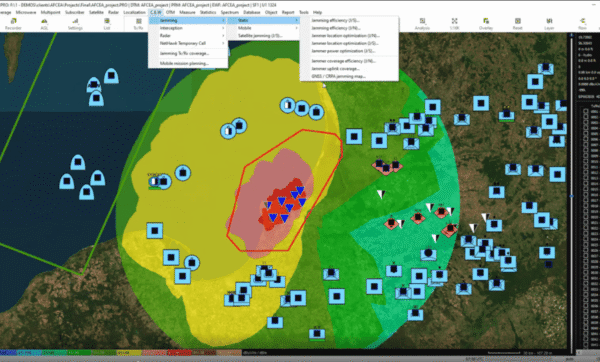
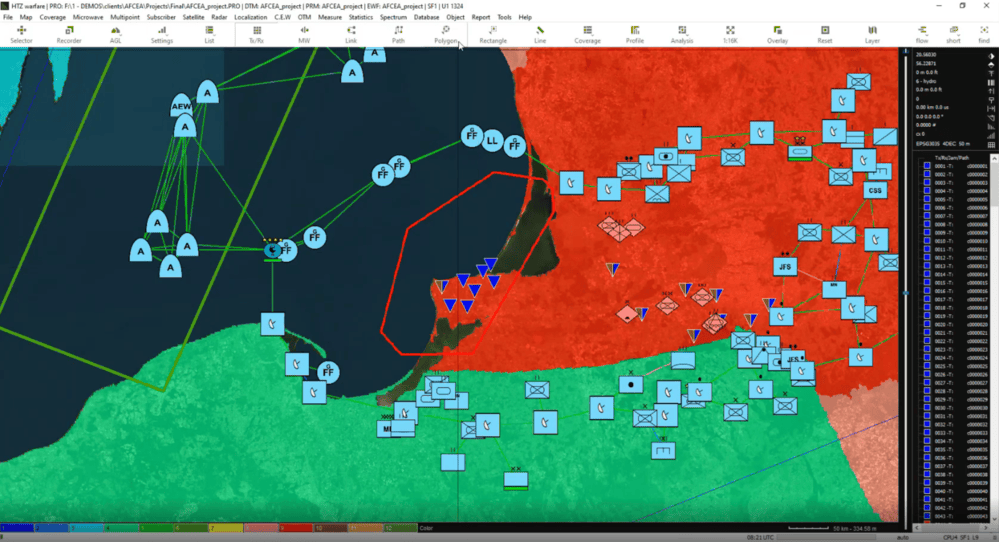
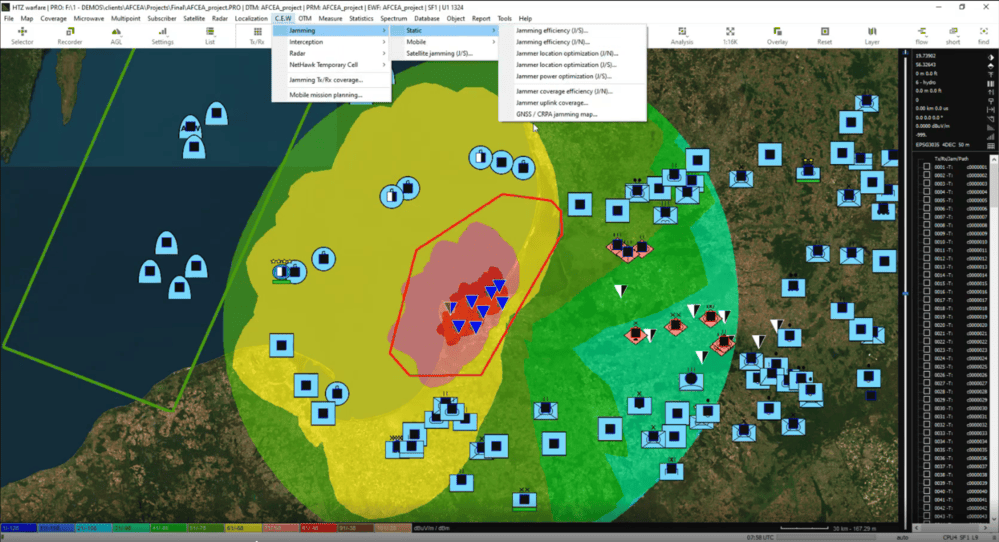
Designed to manage all radio systems across tactical communications, point-to-point and point-to-multipoint links, and electronic warfare applications, HTZ Warfare supports operations across land, sea, air, and space. It simulates complex electromagnetic spectrum combat and defence scenarios within a single application.
Built for mission-critical scenarios, it supports modelling across the full frequency range, enabling seamless multi-domain operations. The solution enables dynamic modelling of mobile assets, including on-the-move units such as UAVs and drones, and performs jamming impact analysis to identify disruption zones while safeguarding friendly communications. This is complemented by intercept and vulnerability assessments against enemy electronic warfare capabilities. Furthermore, advanced 3D terrain-based modelling provides a precise representation of the battlefield environment, accurately reflecting real-world conditions.
HTZ Web API – Embedding Spectrum Intelligence into Defence Architectures
HTZ Web API enables advanced radio planning and modelling capabilities to be embedded directly into existing defence platforms, transforming spectrum engineering into an integrated operational function.
Core capabilities include integration with command-and-control systems and embedding spectrum intelligence within operational workflows, designed for mission purposes. Automated processes support efficient spectrum analysis and simplify mission planning, while real-time data exchange ensures synchronisation between systems. Flexible deployment across cloud and on-premises environments allow organisations to align the solution with their infrastructure and security requirements.
This approach ensures that spectrum intelligence is accessible within customised workflows, reducing the need for complex training and improving consistency across systems.
ICS Monitoring – Persistent Awareness of the Electromagnetic Environment
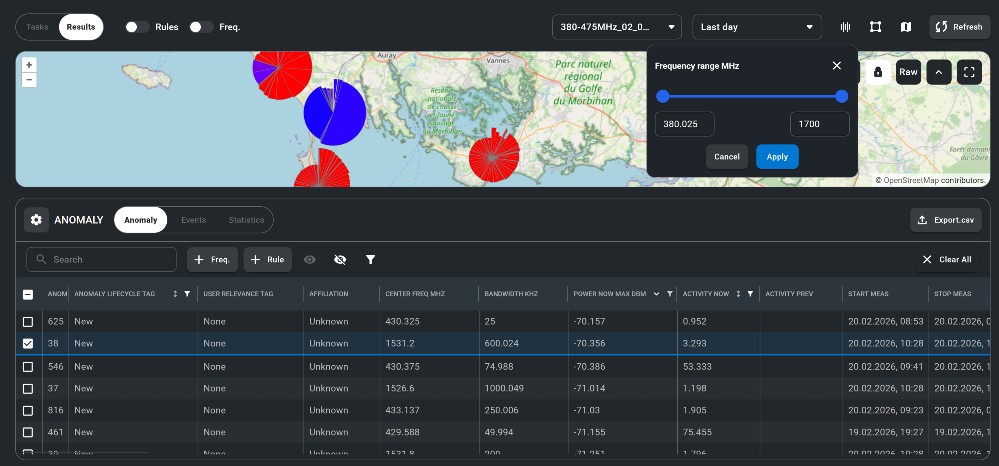
Maintaining visibility of the real-time electromagnetic environment is essential in contested operations. ICS Monitoring provides continuous spectrum assessment, enabling defence organisations to detect, analyse, identify, and classify hostile emissions for targeting.
Its capabilities include persistent surveillance across operational frequency bands, providing constant awareness of the electromagnetic environment. The system localises signals by processing massive datasets from a wide range of monitoring sensors, clustering data into meaningful targets by detecting and analysing anomalous or hostile signals. By integrating remotely with operational jammers, ICS Monitoring enables direct and prompt action against target signals.
By sharing monitoring data with HTZ Warfare, ICS Monitoring creates a closed feedback loop, ensuring real-world conditions inform future operations.
Recent projects include collaborations with the UK Department of Science and Technology Laboratory (DSTL) and the EU military exercise Orion 26.
DSTL UK – In collaboration with the UK’s Defence Science and Technology Laboratory (DSTL), an ongoing project is focused on enhancing electromagnetic situational awareness by combining real-time monitoring with advanced modelling tools. This partnership aims to evolve the HTZ Warfare interface and explore methods for rapid threat identification, supporting faster, more informed operational decision-making in contested environments.
Orion 26 – Led by the French Armed Forces, Orion 26 is a major tri-service exercise designed to prepare units for high-intensity conflict. During the exercise, advanced spectrum modelling using HTZ Warfare enabled engineers to simulate complex electromagnetic environments and identify interference risks prior to deployment. Supported by ICS Monitoring, real-time spectrum activity was assessed to validate assumptions and enhance situational awareness throughout the operation. This combined approach ensured seamless coordination across multiple systems and maintained reliable communications in a contested environment.
About us
ATDI is a global provider of spectrum management and radio engineering solutions, supporting civil and defence organisations for over three decades. Its software and services enable efficient spectrum use, interference mitigation, and operational control across complex and contested electromagnetic environments.