DIU Selects 10 Participants for Upcoming Counter-Drone Demo
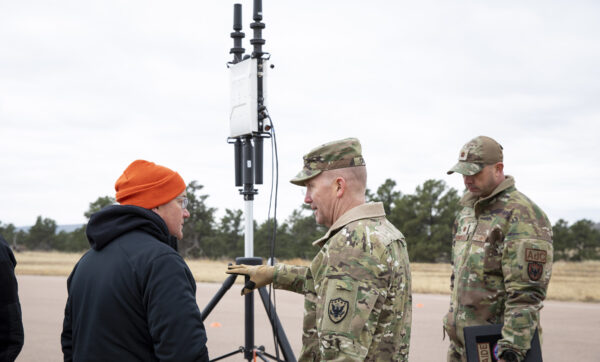


The DOD’s Defense Innovation Unit (DIU) has named 10 companies that will participate in its counter-small unmanned aerial system (C-sUAS) Low Cost Sensor (LCS) Challenge, which is part of US Northern Command’s (USNORTHCOM’s) Falcon Peak 25.2 exercise in September.
Falcon Peak will be conducted at Peterson AFB and Fort Carson sites in Colorado. According to the DIU’s solicitation issued in February, the aim of the LCS Challenge is to assess the ability of multiple C-sUAS sensors and systems to detect, track, identify and conduct high-precision “low collateral defeat” (RF jamming, cyber attacks and nets, for example) against Group 1 and 2 drones, with a priority on detecting “low-emission, non-emitting (dark), and 5G-cell enabled sUAS.” Selected C-sUAS systems represent a variety of technologies, all of which are at TRL 7 or higher.
The companies selected for the LCS Challenge are:
BLUEiQ: Based in Boston, Massachusetts, the company was started in 2023. www.blueiq.us. The company has developed OpenEar, a low-power AI-enabled acoustic sensor, which has been adapted for UUV detection.
CHAOS 1: This company, which began operations in in 2022, is based in Hawthorne, California. https://www.chaosinc.com. Its focus has been developing software algorithms for precision time synchronization to enable drone detection via multi-static radar. Coherent Distributed Networks (CDN). It’s HYDRA system is highly mobile, software-defined system that can perform detection, communications, and deliver electronic effects.
Fortem Technologies: Based in Pleasant Grove, Utah. https://fortemtech.com. The company has developed DroneHunter F700, a drone fitted with a compact AI-enabled AESA radar and a modular countermeasures payload that can dispense different types of nets against Group 1-3 drones.
Guardian RF: Founded in 2024 by a trio of Georgetown University graduates and located in Washington, DC. www.guardianrf.com. The company has developed a passive RF detection system focused on FPV drones.
Hidden Level: Based in Syracuse, New York, and founded 2018. www.hiddenlevel.com. The company has developed a series of passive radar and DF systems – Breaker, Surge and, most recently, Crest, for drone detection and tracking at ranges from 5 km (in urban environments) up to 25 km (in rural settings).
MatrixSpace: Based in Burlington, Massachusetts. www.matrixspace.com. The company has developed a compact radar for low-altitude drone detection with AI classification. In 2024, it won a Direct-to-Phase II SBIR contract from the Air Force for a software-defined low SWAP-C, frequency-agile multi-band antenna that can perform active and passive radar sensing, communications and jamming from a small attritable UAS.
REVOBEAM: Based in Gdansk, Poland. https://revobeam.com. The company has developed multiple configurations of compact, adaptive (beam steering and null steering) antennas for jam-resistant communications between drones and mobile base stations.
Squarehead Technology: Founded in 2004 in Oslo, Norway. www.sqhead.com. It has developed the passive acoustic Discovair sensor (105-degree FOV) that detects and tracks Group 1 and 2 UAS. Multiple sensors can be integrated for 360-degree coverage, and the system uses machine learning to classify drones and separate them from other sounds in the area.
Teledyne FLIR Defense: Based in Wilsonville, Oregon. www.flir.com. This is the only major traditional contractor in the group of selected companies, and it also participated in Falcon Edge 25.1. It has developed a range of solutions, including the Cerberus XL C-UAS trailer-mounted system, which features radar, EO/IR and passive RF detection for Group 1 and 2 UAS, as well as the Argus XL ADA (fixed site) and LVSS ADA (mobile) C-UAS systems.
Thalrix: Based in Worcester, Massachusetts and started in 2024. https://thalrix.com. This company makes a range of C-UAS products, including the Thalrix Hawk Group 1 and 2 drone-based interceptor, which can be operated in surveillance mode (to detect incoming drones) and “point to kill” mode to physically intercept the enemy drone. The company has also developed a pair of technology packages for their intercept drones: Terral Navigation (for GPS-denied environments) and Thalrix Dead-Eye (an AI-powered visual targeting algorithm).
According to DIU, these 10 companies were selected from 118 candidates. It added, “Beyond the prize money, top performers may also be considered for follow-on opportunities, including Other Transaction (OT) agreements, a Cooperative Research and Development Agreement (CRADA), and direct transition into operational use, accelerating the deployment of these capabilities and making the best tech available to the warfighter with the speed and scale required.” – J. Knowles