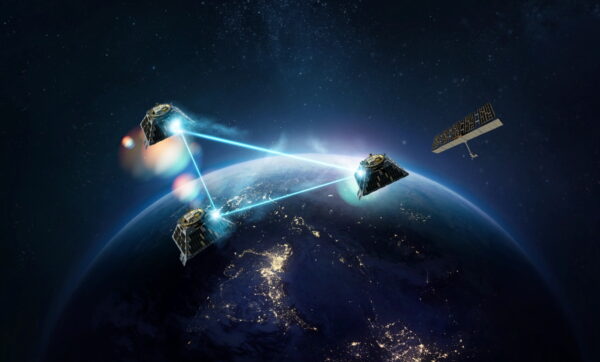


A cluster of three Azalea radio frequency (RF) satellites has been successfully launched into low Earth orbit, marking a key milestone for BAE Systems’ ambitions to establish a UK space-based intelligence, surveillance and reconnaissance (ISR) service.
The self-funded Azalea constellation was launched via Exolaunch as part of the Transporter-15 rideshare mission with SpaceX on November 28. Communications with the satellites were successfully established across the first three contact opportunities.
Flying in formation 350 miles above Earth, the 150-kg Azelea satellites will collect multiple sources of data – including wideband RF and Synthetic Aperture Radar (SAR) – using technology provided by Finnish firm ICEYE. They are joined by an additional ICEYE SAR satellite, launched aboard the same Transporter-15 mission, which becomes part of a four-satellite cluster.
Over the coming months, BAE Systems will trial the fusion of RF and SAR data, collaborating with customers to explore a range of use cases. “When compared to existing space-based sensors and traditional data transfer processes, the Azalea system will save valuable time by combining and analyzing data in space,” the company said, adding: “Unlike conventional, single-purpose satellites, the Azalea cluster will be reconfigurable whilst in orbit in the same way that a smartphone installs a new app.”
BAE Systems’ Azalea Enhanced Software Defined Radio (SDR) and data processor forms the central part of the RF and processing chains on Azalea. “Through its use of multiple antennas and radio head units, the Enhanced SDR supports space-to-ground links, space-to-space links, and advanced RF monitoring capabilities,” the company said. “Local processing resources interface to other platform functions, such as imaging and data storage, for a fully encompassing capability.” – R. Scott