
General Dynamics Demonstrates Leonidas C-UAS Capability on AGV


By Andrew White
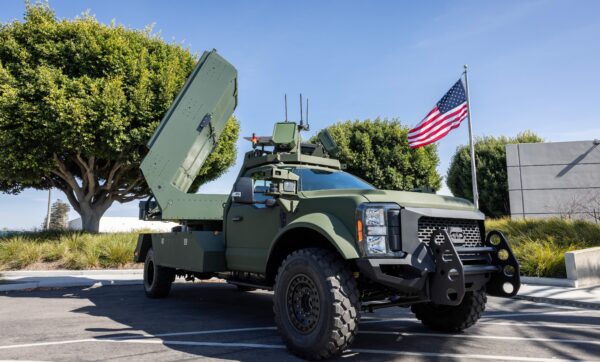
Epirus teamed up with General Dynamics Land Systems (GDLS) and Kodiak AI to unveil the latest variant in its family of it Leonidas High Power Microwave (HPM) systems.
The Leonidas Autonomous Ground Vehicle (AGV) which was displayed for the first time at the AUSA Global Force Symposium & Exhibition in Huntsville, Ala. on March 24. The Leonidas HPM system was shown on board a Ford F-650 4×4 truck. Integrated by GDLS and featuring Kodiak AI’s autonomous driving system, the Leonidas AGV has been designed to conduct “mobile and autonomous” counter-UAS operations, according to Epirus.
A company spokesperson told JED the solution could be integrated on board any commercial truck with sufficient payload capacity, describing the HPM system could be scaled up or down via its modular Line Replaceable Amplifier Module (LRAM) technology.
Leonidas’s open architecture means it can network with a range of on-board sensors and software. Examples include Echodyne radars, L3Harris WESCAM gimbals and Anduril’s Lattice command and control software.
According to a joint statement published by the three companies, the Leonidas AGV is designed to support “critical point defense and homeland security missions” across a variety of environments. “Leonidas AGV delivers a mobile counter-UAS capability that can be operated without human intervention or tele-operated to extend the counter-UAS line of defense across fixed-site and expeditionary mission sets. [It] can rapidly deploy to pre-planned intercept points or maneuver across a perimeter to protect critical assets from the threat of individual, swarm or fiber-optic controlled drone attacks,” the statement added.
As a software-driven solution, the Leonidas uses solid-state, long-pulse HPM technology and Gallium Nitride (GaN) semiconductors to disrupt the electronic systems and “neutralize individual drones and saturation swarm attacks without expending costly and limited interceptors, creating a resilient and low-collateral close-in defense layer for critical assets and infrastructure,” the statement continued.
According to Epirus CEO, Andy Lowery, saturation attacks by UAS “demand a fundamentally different approach to defense,” he said in the press statement, adding, “Leonidas AGV combines autonomous mobility with high-power microwave effects to deliver a counter-UAS capability that rapidly maneuvers to defeat drone swarms without more boots on the ground.”
The Epirus company official also informed JED about plans to demonstrate the Leonidas AGV’s capabilities in the “coming months.”
Disclosure of the Leonidas AGV is the latest in a string of developments being undertaken by Epirus and partners across the US Department of Defense. Epirus continues to support a pair of ongoing contracts with the US Army and Marine Corps respectively.
The company has a total of six units fielded as part of the army’s Indirect Fire Protection Capability (IFPC) HPM contract. This includes two Gen-2 HPM systems with “enhanced range” capacity, the company official confirmed to JED. The contract has already seen Leonidas HPM supporting several exercises around the world. These include the Indo-Pacific Command (INDOPACOM) Exercise Balikatan in the Philippines, and another undisclosed exercise elsewhere in the world. “We expect a live [operational]deployment soon,” the official suggested to JED.
Epirus also continues to support the Marine Corps’ Expeditionary Directed Energy Counter-Swarm (ExDECS) solution. Currently, the Marines have deployed a single Leonidas system towed behind an Oshkosh 4×4 Joint Light Tactical Vehicle (JLTV). The official explained to JED the USMC deployment was more of a “developmental” effort in comparison to the army’s IFPC-HPM.