
SCEPTER Project Kicks Off under EDF Framework


By Richard Scott
Spain’s Indra Group is leading a nine-nation European industry consortium in the design and development of a next-generation multifunction radio frequency (RF) suite intended to integrate advanced radar, electronic warfare (EW) and communications functions in a single “intelligent” active electronically scanned array (AESA) architecture.
Sponsored by the European Defence Fund (EDF), the SCEPTER (European Multifunction System Concept applied to Communications, Electronic Warfare and Radar) project has set out to build and validate a demonstrator based on off-the-shelf AESA technology and hardware components. Representing a total EU investment of €35 million, SCEPTER is a follow-on from the earlier Preparatory Action on Defence Research (PADR) CROWN (Combined Radar, cOmmunications, and electronic Warfare fuNctions) project, which was also led by Indra.
Kicking off at the start of 2026, the SCEPTER initiative is intended to advance European sovereign technology and understanding in multifunction RF systems and architectures, including areas such as broadband AESA antennas, direct signal digitization and dynamic resource management. The four-year project will culminate in the demonstration of the system’s main functional blocks, including radiating panels, RF transmit/receive modules, digital back-end solutions, and an advanced resource management component.
According to the EDF, SCEPTER seeks to combine radar, EW, and communication functions with adaptive cognitive features, enhancing situational awareness across air, land, and sea domains. Key goals include the development of modular and interoperable system architectures; establishing standardized hardware and software components to increase operational flexibility while minimizing electromagnetic spectrum utilization; and developing and integrating advanced antennas against strict requirements for size, weight, and power in airborne platforms. Additionally, the program will address challenges in thermal management and signal integrity to ensure robust performance across different environments.
“The goal is to respond to the increasing complexity and saturation of the electromagnetic environment, multi-domain scenarios, and the need to reduce the size, weight, and power of defence platforms, especially critical in aircraft, to provide an operational advantage against the enemy,” Indra said, adding: “The application of artificial intelligence and cognitive architectures in managing the electromagnetic spectrum is one of SCEPTER’s major differentiating factors, which will enable future platforms to operate with greater efficiency, resilience and adaptability.”
Indra is coordinator for the SCEPTER consortium, which includes primes, small/medium enterprises, technology centers and universities from Estonia, France, Germany, Italy, Lithuania, The Netherlands, Poland, Sweden. Other consortium participants comprise: BPTI (Lithuania), CAFA Tech (Estonia), CNIT, ELT and Leonardo (Italy), Fraunhofer and Hensoldt (Germany), TNO (Netherlands), ONERA and Thales (France), Saab and FOI (Sweden) and XY Sensing (Poland).
Key strands of SCEPTER include the development of multifunction ultra-wideband AESA radars and high-efficiency RF modules; the use of advanced gallium nitride (GaN) semi-conductor technology enabling more powerful, compact and energy-efficient devices; and the maturation of digital back-end/resource management systems leveraging Artificial Intelligence/Machine Learning techniques. According to Indra, the project also incorporates “adaptive and cognitive design approaches that facilitate dynamic waveform optimization, threat detection and classification, and operation in complex electromagnetic environments, along with advanced modelling, simulation, and Digital Twin methodologies aimed at accelerating system development and validation.”
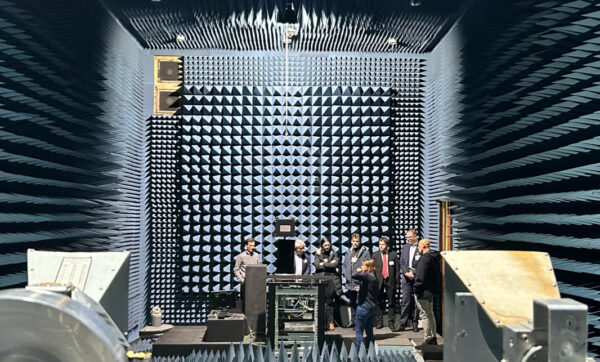
PADR CROWN, as the forerunner to SCEPTER, was a €10 million, 32-month project to design, develop and test a small-scale multifunction RF system prototype integrating radar, EW, and communications. Concluding in early 2024, CROWN involved 11 different work packages, with component building blocks demonstration in a controlled anechoic chamber environment.
The promise shown by CROWN, which was primarily focused on critical technologies applicable to crewed and uncrewed airborne surveillance platforms, established the foundations for what became SCEPTER. The CROWN project also informed necessary investments, planned milestones, and research activities required for the development of a TRL7 prototype demonstration in an operational environment.