How the AOC Took Flight: The People and Chapters That Shaped Its First Decade


The following article was written by the AOC History Committee and published in the February 2024 issue of the Journal of Electromagnetic Dominance (JED) as part of the the association’s 60th anniversary celebration.
Following the AOC’s founding in 1964, it’s future was not a certainty in its early days. Building the association beyond those first 130 members who signed up at the inaugural banquet required a lot of hard work from many different people. Yet the AOC did grow, adding chapters, events, and even a regular publication for its members.
Early Chapters
The first chapter of the AOC was the Kittyhawk Club (now the Kittyhawk Chapter), which was formed in late 1964. Wright-Patterson AFB was already a major aerospace technology hub, and it was also the home of major Air Force EW technology development and systems acquisition organizations. The Kittyhawk Club included many Air Force officers, but it’s real strength was the civilian workforce who developed EW technologies. These would become some of the most vocal advocates for EW funding and programs over the next two decades.
Other early chapters included:
- The Capitol Club in Washington, DC, which included many senior EW officials (military and civilian) from the Pentagon and surrounding military bases.
- The Mugu Crows Club in Camarillo, CA, was founded in October 1965 as the third AOC chapter. Based around one of the US Navy’s major EW centers, the Mugu crows host one of the AOC’s longest running events, the Collaborative EW Symposium.
- Tri-State Club, New York City, NY
- Strategic Air Command (SAC) Roost Club, Offutt Air Force Base, NE
- Pikes Peak Roost, Colorado Springs, CO
- Golden West Club, Los Angeles, CA
- Espirit De Crow Club, Homestead Air Force Base, FL
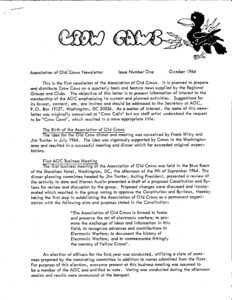
Crow Caws
The AOC was founded as both a fraternal and a professional organization. Old squadron mates wanted to keep track of each other and maintain their network, and at the same time, the AOC wanted to help grow discipline of EW and guide its future. This meant the AOC needed to push all kinds of information out to its members.
Shortly after the AOC’s “first supper” (September 9, 1964), Bernie Zettl began compiling material for a publication named Crow Caws that would soon become a quarterly newsletter for AOC members. By the end of 1966, the AOC had grown to 2,300 members, and Crow Caws had evolved from a newsletter to a magazine.
Crow Caws began featuring technical articles in 1967. These included “Dynamic Radar Cross-Section,” by R.F. “Reb” Russell of Boeing and F.M. Belrose of Redstone Arsenal, and “Video Recording as Applied to ECM Testing,” by Lt Thomas E. Simondi of the Air Proving Ground Center at Eglin AFB. Also in 1967, Crow Caws began publishing a regular column, “Operator 750,” by Dan Graves at the Kittyhawk Club. Graves was an AOC institution. He seemed to know just about everyone, and he wrote with humor and passion about people, news and events across the AOC community making it seem like a small, close-knit community even as it continued to grow very quickly.
By 1969, Crow Caws would become Electronic Warfare magazine that was published every two months, before again rebranding as the Journal of Electronic Defense (JED) in the summer of 1978.
Professional Development and Awards
When the AOC board held its first official meeting in March 1965, it began to discuss its vision for serving the EW profession. From the beginning, it recognized the need for professional development, and in 1967 the board established a Technical Education Committee charged with creating and delivering a series of technical short courses that would build and strengthen the knowledge levels of EW engineers. This evolved into today’s AOC Professional Development Courses.
That first AOC board meeting also established the AOC Awards Program to recognize professional excellence. The Awards Committee designated the first AOC Awards: the Special Citation Award, the Certificate of Merit, and the Honorary Membership Certificate.
The AOC of the 1960s was an all-volunteer organization that had a vision and a determination to grow and be relevant. By the next decade, it would evolve into a professionally staffed organization that would continue its mission with tremendous success.