First-Person Singular: Hal Gershanoff


HAL GERSHANOFF – 2002
Hal Gershanoff was publisher and editor of the Journal of Electronic Defense (JED) for more than two decades. After his retirement, he continued to make important contributions to AOC as a member of its Board of Directors.
I had already been a member of the AOC for about five years when I was offered the job as publisher of JED. Perhaps it was because I was the only employee in our publishing and exhibition-management organization that was a member that I got the offer in the first place. An earlier marketing job with a company that produced amplifiers for EW simulators prompted me to join the AOC way back in ’75.
Before that, I had a couple of tours in ’Nam, installing, testing, and operating some specialized military-electronics systems for a (then) division of Northrop. My close encounter of the worst kind with a dozen Viet Cong (VC) one night near Danang took place very early in that war. Fortunately it was so early that it was the French who were then considered by the VC to be the bad guys. As an obviously young, obviously American, obviously unarmed, and obviously scared-to-death and harmless soul, the black pajama’d, bolt-action-rifle-toting group let me pass. Otherwise, my story would have probably ended right there.
But, to continue. Horizon House Publications had won the competition to produce the AOC magazine some months before. Horizon House took over the AOC publication (earlier called EW Magazine) and initially assigned the dual role to the (then) publisher of the Microwave Journal, a second title in the company’s stable of publications. At the outset, it was not a marriage made in heaven. Ad sales were dismal, and the previous issues were barely breaking even when I took over for the November-December 1980 issue (we were on a bimonthly schedule back then).
At the time, I knew very little about publishing other than all revenues came from advertising. I decided that I’d best get to know the advertisers, so I made a list of the ones that ran ads with some regularity and intended to contact them to introduce myself as the new publisher of JED. Leading that list was a Long Island, NY-based EW company, AIL, which had the contract to produce the EW suite for the B-1. I called Dick Dunne, their ad manager to introduce myself. The conversation went something like this:
“Mr. Dunne, my name is Hal Gershanoff, the new publisher of the Journal of Electronic Defense and I’m calling to introduce myself and to thank you for your advertising support.” I said.
“Every time I run an ad in JED it pains me” he said, “since I feel that I’m making an investment in your magazine, and you’re not.”
“Gulp.”
He went on to itemize all the things he felt were wrong with JED, while I feverishly scribbled notes. When he paused for a breath, I asked, “Are you working from a prepared list?”
That may have been the most useful introduction to my new job that I could have received. That afternoon, I sent him a three-page letter, delineating where I felt he was right, where he was wrong, and where his complaints about the magazine were somewhat subjective. The good news is that, over the following months, the staff we assembled changed things, and Dick soon became one of our strongest supporters. That, plus the fact that my taking over was coincident with our having the best defense/aerospace advertising salesman ever, in the person of Ronald Reagan, entering the White House, made things a lot easier from that point forward. His re-energized focus on defense preparedness had dozens of additional companies scrambling to gain recognition in our very exclusive EW-suppliers club.
Timing is everything, and mine couldn’t have been better.
Soon, we had increased publication frequency to a monthly schedule, were adding editorial color to the magazine, instituting design changes, forming an Editorial Advisory Board, assembling a talented editorial staff, and beginning to get recognition as a credible source of information about EW and related disciplines.
One of the key challenges facing JED revolved around the issue of security. After all, a survey we conducted pointed to some astounding reader demographics. It showed that 95% of JED readers had at least a secret clearance, while 50% of those held top-secret and 40% compartmented clearances.
How does one produce an unclassified magazine for an audience whose motto is “I’d tell you what I do, but then I’d have to shoot you?”
Early on, I decided that it would be insane for me or any of the JED staff to hold a security clearance. Thus, anything we wrote in JED would be, by definition, unclassified. We also advised authors who contributed articles that it was their responsibility to get these cleared if need be.
That said, there were a few dicey incidents over the years, a very few.
One of these involved a paper included in the unclassified conference proceedings from the Fiesta Crow symposium in San Antonio TX some time in the ‘80s. It was at the height of the cold war, and a colonel with the US Air Force in Europe presented a paper which in effect said, “When and if the balloon goes up over the Fulda Gap invasion route to the heart of Europe (and NATO goes to war with the Soviets), we don’t have to worry about their jamming us, ‘cause we will be so jamming the shit out of each other, what they might do won’t make much of a difference.” It went on with a full page of references from unclassified sources to support this thesis.
Great paper, I thought. We should article-ize it for JED. Problem was, I wanted the authors permission, and did not know how to reach him. I turned to HQ USAF at the Pentagon for help, and sent them a copy of the proceedings. To my astonishment, what I got back was a registered letter demanding that we not publish the paper, since the USAF considered it secret (regardless of its having been included in unclassified proceedings). The reason: It pointed to a military vulnerability, and as authored by a uniformed officer, it had credibility. Thus “vulnerability” + “credibility” = secret, at least in the eyes of the USAF.
Then there was the instance of the five blank pages. Very early on, we planned to run a cover story from what was then the General Electric Corporation, treating the EW antenna developments they were doing for Wright Labs. That is until the Air Force decided that the manuscript that GE had (already) sent us was secret. We had no unpublished article backlog, and I needed to find a way to fill the five blank pages in the issue. We came up with the idea of running an organizational profile of the Army Intel school at Fort Devens, MA, primarily because of geography. It was within an hour’s driving distance of our offices. A call to the then deputy commandant and AOC activist, the late Dr. Jack Ledger, resulted in an invitation to visit and profile the school, under the condition that we allow them to review the manuscript prior to publication. After all, their biggest customer was the National Security Agency (NSA), and NSA was not known to be particularly forthcoming about its activities.
So our managing editor and I visited the facility, met with Jack and then Commandant Col. Joe Short (now the AOC’s assistant executive director), and viewed the two-podium dog-and-pony presentation where an Army major at one and a senior master sergeant at the other presented an unclassified slideshow briefing on what they did there. We requested and received a copy of their script as well as the unclassified curriculum booklet to help us prepare the article. We returned the next day to interview a few students and some of the teaching cadre. By the end of that week, the draft manuscript was under review by Fort Devens staff. The only changes they requested was that we use the term “Northern Europe” rather than the specific location where some of the graduates were headed for their “listening” assignments. Our article “The Invisible War” appeared that December.
In early January, while on a business trip to California, I received a panic call from my secretary indicating that the Army, at the request of their NSA customer, wanted to interview me about breach of security. Representatives from Fort Devens and their parent command in Texas came to visit me in my office the following Sunday, where I showed them supporting evidence proving that we had obtained release of the final (as published) manuscript. Although they were careful to not disclose precisely what was classified in the article, it appeared obvious that the offending details came from the printed (presumably unclassified) material we were given and not from the interviews we conducted — an apparent “disconnect” between the views held by Fort Devens and Fort Meade (home of the NSA). A few months later, I met with the then NSA commander and apologized for the lapse, he surprised me by showing he was aware of the incident, and quickly absolved us of any blame by commending our willingness to agree to prepublication review, something that few if any other publications would accept.
But enough of the administrative stuff about producing JED, and on to the fun parts — the really fun parts.
It seems that back before the Soviets turned out to be such unreliable adversaries, the US military services were more amenable to giving journalists media rides in shit-hot aircraft than they are today. You know the adage that the only difference between men and boys is the price of their toys. Well, let me tell you that the B-52 Stratafortress, EA-6B Prowler, F-4G Wild Weasel and F/A-18 Hornet are not just toys, they’re TOYS! And I got a chance to ride in (and in some cases even control) all of them. Wow!
But first, I had to go to “survival” school.
The Air Force survival training was a piece of cake, except that they insisted on my shaving off my beard (something about how the oxygen mask would fit in an altitude chamber). So I begrudgingly shaved the beard, passed the test, and then, to add insult to injury, the Air Force cancelled my initial request for a ride in the Weasel (an action later reversed and put right by MG Tom Swalm, then commander of the Tactical Air Warfare Center and member of the JED Editorial Advisory Board). On the other hand, the Navy insisted on conducting its own survival training (surprise, surprise), but they let me keep the beard. This time, however, it was definitely not a piece of cake. Like the trainees in the movie “An Officer And A Gentleman,” they turned me every which way but loose for two and a half days at their facility at Whidbey Island, WA. That included altitude chamber, ejection-seat simulator, being towed by your parachute harness across the surface of an Olympic-size pool, treading water in full flight gear and boots for half an hour, using your oxygen mask as a device at the bottom of that pool (in my bearded condition, a little Vaseline helped a lot), and the high point, the Dilbert Dunker, which has you popping your canopy and getting out of a flooded cockpit at the bottom of the pool before you sleep with the fishes.
All this training led to an oh-dark-thirty wake up call for a B-52 low-level, nap-of-earth training mission out of Grand Forks AFB, NE, where I discovered that the B-52 may look big from the outside, but has precious little room for people inside, and that this starving journalist will eat his fried-chicken lunch at an earlier hour than he normally eats breakfast, and that at low levels, the Buff’s terrain-avoidance and autopilot system produces a smoother ride than under the control of a pilot.
Then there was the back seat of the EA-6B out of Whidbey, where I became convinced that electronic attack; stand-off, stand-in, and escort jamming; and defense suppression needed lots of highly skilled, trained and motivated electronic-warfare officers (the more the better to fiddle with the myriad of knobs, dials and displays under their control), and that the initial USN decision not to equip the Prowler with the AGM-88 HARM anti-radiation missile was dumber than dogdoo. I subsequently wrote a JED article saying so, which might have contributed to a reversal of that idiotic stance.
In another back seat, this one in an F-4G Wild Weasel flying out of George AFB, ID, over the Tonopah training range near Nellis AFB, NV, I learned that my pilot in the front seat didn’t particularly like journalists. My biggest kick came from our grouping up with another F-4G and flying wingtip to wingtip for a while only to have the other guy break away far right and behind us until he was just a glint of light on the horizon, with me craning my neck to keep him spotted, at which point my pilot throws us into a high G turn. Since my head now weighed some 150 pounds, I was sure I was to become the first media fatality of the year. This was followed by 20 minutes or so of twisting, jinking, and death-defying, high-speed, low altitude maneuvers at what appeared to be a sustained 3-4 Gs. All I could do was pray for some negative Gs to redistribute my internal organs back to at least the approximate neighborhood of where they usually resided.
For a while it seemed that my F/A-18 ride was not to be. It started with an invitation from the EW test folks at Patuxent River, MD, to come down for the inauguration of their new anechoic chamber. I went, and one of my hosts thought that I should return for a media ride in the Hornet. I gave the idea due consideration (about 1.3 nanoseconds) and jumped at the chance. But when the idea got to the then skipper at Pax River, he nixed the idea. Now, fast forward a few months to a profile we were doing of the Naval Air Systems Command (NAVAIR). My interview with the then NAVAIR commander went great, and the “chemistry” between us could not have been better. The scheduled half hour ran to three times that, and as I was leaving his office, he asked if there was anything else he could do. “Well, there is one thing,” I responded, and told him of my dashed hopes for the Hornet ride. The following week, the people at Pax River were calling me to find out when it might be convenient for me to come down for a rescheduled flight.
Here’s how it went; bitterly cold day; the pilot walking the entire length of the runway looking for chunks of ice that could be ingested into our engines; two-place Hornet used only for training and weapons-separation testing so no G-suit hookup; a V-MAX takeoff which had our nose pointing straight up at the end of the runway and burning a hole in the sky five miles high, and my brief red-out tunnel-vision period confirmed when I later saw the multi-function display registering a momentary peak of 7.1 Gs at some point in the flight; me taking the aircraft through a loop over the Chesapeake Bay.
Did I say “WOW” before? That barely describes it. Good thing my company didn’t know how great all this was and continued to pay me a salary. I would have paid them for the opportunity.
Space doesn’t permit my recounting details of the trip resulting from the kind invitation from the German Air Force to tour their EW and facilities, but the resulting article in JED describes the impressive job they were and are doing. Nor can I adequately summarize the generous invitation to be the keynote speaker for the AOC symposium in Pretoria, South Africa, including the opportunity to see their facilities and be blown away by seeing how high a priority they place on EW and how much they have accomplished for so little.
My involvement, first as a member, then a director, and finally as president of the Aviation and Space Writers Association was filled with high points, since it presented opportunities to collect friends and associates among the world’s leading trade- and general-press organizations who considered aviation (and by extension military electronics/avionics) their beat, along with their counterparts, the communicators in the global companies that produce these systems.
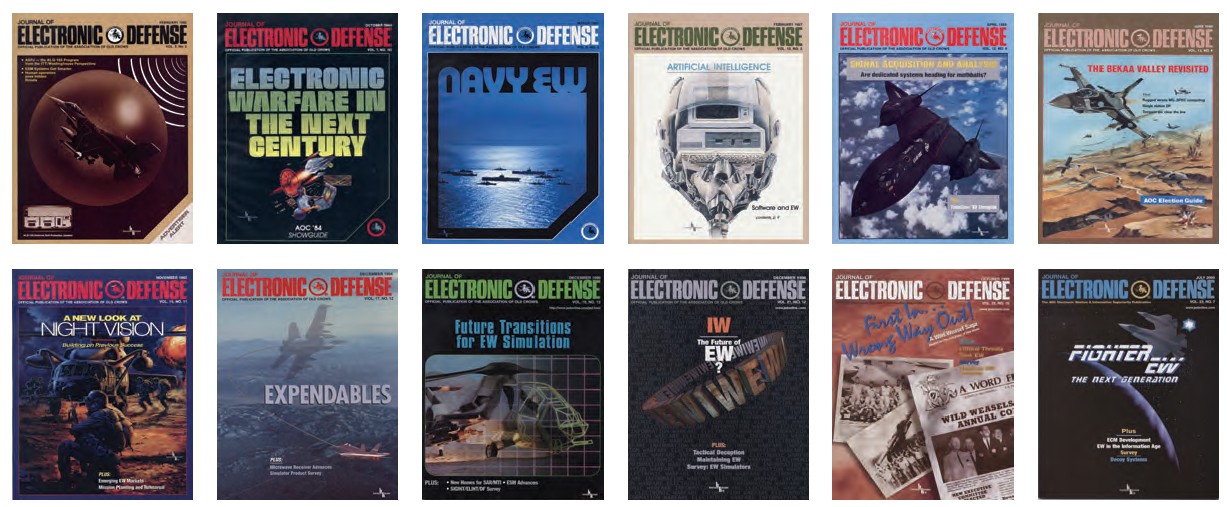
The bookcase in my office contains no less than four running feet of the bound copies of JED produced over these past twenty-two years. Contained on those thousands of pages is much of the story of the contributions that you and other EW professionals have made to our community.
I am proud to have helped document and to have been part of that contribution.