The Decade That Tested, Transformed EW and AOC


The following article was published in the March 2024 issue of the Journal of Electromagnetic Dominance (JED) as part of the AOC’s 60th anniversary celebration.
By Wayne Shaw with contributions from Ken Mathisameier, Sam Roberts and Paul Westcott
The 1970s was the best of times and the worst of times for electromagnetic warfare (EW). As the Vietnam War continued into the 1970s, EW was mainly being used by Electronic Warfare Officers (EWOs) in the USAF’s B-52 and EB-66 aircraft and also by Naval Flight Officers (NFOs) in a variety of US Navy and US Marine Corps aircraft, such as the EA-6A, as well as the EA-6B, which was introduced in 1972.
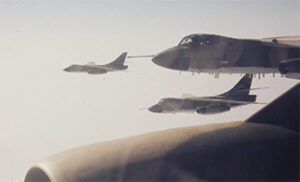
The B-52 was fitted with equipment to counter antiaircraft artillery, surface-to-air missiles (SAMs), aircraft interceptor and enemy communications to protect the aircraft itself. The EB-66E with one EWO was used as a standoff jammer to deny and degrade enemy radar systems to protect other penetrating aircraft. With a minor jamming capability, the EB-66C with four EWOs was used as a reconnaissance aircraft to identify and locate enemy radars and communications. The EB-66 was also fitted with many Quick Reaction Capabilities (QRCs) to counter evolving threats, such as infrared missiles and frequency hopping communications. USAF fighter aircraft, such as the F-105G, F-4 and others were being fitted with EW pods and other add-on self-protection gear and missiles to attack SAM systems. Many EWOs and NFOs gained valuable combat experience in the Vietnam War.
After Linebacker II in December 1972 and the winding down of the Vietnam War, came worse times for EW. As the war ended in 1973, the DOD’s emphasis on EW decreased. The EB-66s were flown to Clark AFB in the Philippines and their EW systems were removed and put in storage as spares for the B-52. This left the USAF with no tactical EW aircraft. Much of the funding for EW systems was allocated elsewhere because it was believed a strong tactical EW capability was not needed. EWOs were assigned as instructors at the USAF EW School House, returned to B-52 duty, or were assigned to the RC-135.
While the Navy and Marine Corp moved ahead with the EA-6B in the 1970s, the Air Force’s portion of the airborne electronic attack mission was at a standstill through the mid-1970s. In the late 1970s (and into the early 1980s), the Air Force decided to reinvigorate its EW mission with development of the EF-111 Raven and EC-130H Compass Call. The new EW equipment shifted from hard-wired to software-capable systems, which would rely on the EW Integrated Reprogrammable Data Base. As the equipment changed, so did the EWO/NFO skill sets, which evolved from a pure “knob twister” in the 1970s to more of an ESM/ECM manager armed with sophisticated software-driven equipment using database information to help identify threats and manage jamming resources.
The 1970s also saw AOC make significant steps forward, transitioning from a purely volunteer-driven endeavor to a professionally staffed organization. Mary Blackmon, wife of Lt Col Larry Blackmon, volunteered as the first AOC Executive Director. She was followed by Gus Slayton, who was appointed as the first paid AOC Executive Director. This heralded a new era of professionalism and organizational growth, and the AOC began to pursue on a trajectory toward greater influence and efficacy within the EW community.
Establishing itself as a legal entity, AOC embarked on a series of foundational activities: bank accounts were opened, meticulous plans were laid for annual conventions, membership drives were held, and a “permanent” headquarters at 1750 Pennsylvania Avenue NW, Suite 1316, Washington, DC, was established. The recruitment of dedicated staff and the rental of office space underscored the association’s commitment to fostering a robust infrastructure to support its objectives. The AOC also entered the international arena in the 1970s, when the first International Convention was held in Bonn, Germany, primarily staffed by volunteers.
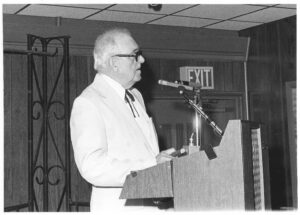
Among the ranks of dedicated volunteers, Dan Graves emerged as a stalwart figure, earning renown as the go-to individual for annual conventions and a sought-after speaker for AOC. His unwavering dedication exemplified the spirit of service that permeated the AOC’s ethos, further cementing its standing within the EW community.
In these formative years, AOC epitomized the power of collaboration, vision, and perseverance. From humble beginnings to a beacon of expertise and advocacy, the AOC’s journey stands as a testament to the enduring impact of passionate individuals united in a common cause. It was the best and worst of times, but important foundational pieces were put in place for the future of EW and more broadly electromagnetic spectrum operations in the 1970s.