You Know Chaff. It’s Time You Knew Her
The Story of Lady Joan Curran, the Physicist Behind One of EW's Most Enduring Countermeasures


By Christelle Ward
Every capability has an origin story.
Some become inseparable from the people who created them. Others become so woven into the profession that we know exactly how to employ them but rarely stop to ask where they came from.
As operators, we spend years mastering the electromagnetic spectrum. We learn how to detect, identify, exploit, deceive, protect, and deny. We inherit these capabilities from the generations of engineers, scientists, and operators who came before us, trusting that they will perform when they are needed most.
But have we ever stopped to wonder where those capabilities began?
As an Electromagnetic Warfare (EW) Operator in the US Navy, I understood how to employ chaff and the role it played in protecting the force. Yet, despite relying on one of the most enduring countermeasures in EW, I never stopped to ask a simple question: Who first looked at radar and wondered if it could be deceived?
It begins not with a weapon or a platform, but with a physicist whose quiet ingenuity helped change the course of World War II and laid the foundation for one of the most enduring countermeasures in EW history.
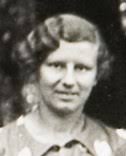
Her name was Lady Joan Curran.
By the early years of World War II, radar had fundamentally changed the air war. Darkness, weather, and altitude no longer provided the protection they once had. The challenge was no longer how to destroy enemy radar, but how to make it believe something that wasn’t true. Long before EW became a recognized discipline, Lady Joan Curran and her colleagues were already working to answer that question.
Born in 1916, Joan Elizabeth Strothers earned a scholarship to Newnham College, Cambridge, where she studied physics at a time when few women pursued the discipline. Although she completed the requirements for an honors degree in 1937, Cambridge University did not award degrees to women.
Following Cambridge, Curran continued her research at the Cavendish Laboratory, where she met fellow physicist Samuel Curran. The two shared a passion for experimental physics and married in 1940, just as the demands of war transformed scientific research across Britain.
After early work on the proximity fuse, Joan and Sam were transferred to the Telecommunications Research Establishment (TRE), Britain’s premier radar research organization. At the TRE, Curran joined the Countermeasures Group and confronted one of the war’s most consequential technical challenges: how to defeat enemy radar without destroying it. Rather than asking how to eliminate the radar, Curran instead asked if it could be deceived?
Like every good problem solver, Curran experimented relentlessly with different radar reflectors, discarding failures until she found a practical solution capable of creating false radar returns without burdening Allied aircrews or disrupting operations.
According to her husband, fellow physicist Samuel Curran, Joan spent evenings at home cutting thousands of thin strips of aluminum foil with ordinary household scissors, preparing them for flight trials. Those seemingly unremarkable strips were then dropped from an aircraft while radar operators observed the results. Instead of tracking a single aircraft, their radar displays suddenly filled with what appeared to be a massive formation of bombers.
The results demonstrated something extraordinary. The radar had not failed. Yet it could no longer distinguish genuine aircraft from the expanding cloud of reflected signals. The adversary’s sensors had not been destroyed; their confidence in what they were seeing had.
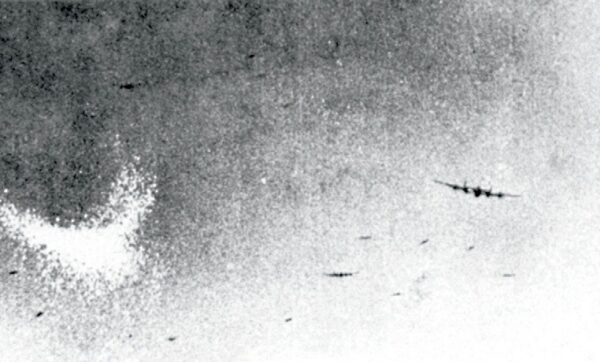
The deceptively simple innovation became known as window. More than 80 years later, operators around the world know it by another name: chaff.
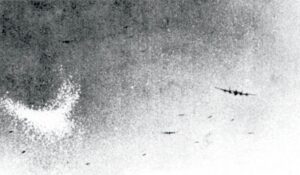
Although window proved successful during testing, Allied leaders delayed its operational use for more than a year, fearing Germany would quickly develop its own countermeasure. That changed during Operation Gomorrah in July 1943, when window was employed on a large scale for the first time. German radar operators suddenly found themselves unable to distinguish real aircraft from false returns. Less than a year later, the same invention became a critical part of the deception campaign supporting the D-Day landings, helping convince German radar that phantom invasion fleets were approaching elsewhere while Allied forces crossed into Normandy.
Window proved that victory in the electromagnetic spectrum did not always require destroying an adversary’s capability. Sometimes, the decisive advantage came from convincing an adversary to trust information that was no longer accurate.
Like many wartime scientific achievements, Curran’s contribution did not receive immediate public recognition. Much of her work remained classified, and although she and her husband continued distinguished scientific careers after the war, her role in developing window remained largely unknown outside historical and technical circles. More than eighty years later, operators continue to trust a capability born from Curran’s curiosity, persistence, and willingness to ask a question no one else had: Could radar itself be deceived?
Every capability has an origin story.
For chaff, that story began with a woman with an idea, and a simple pair of household scissors.
_____
A Historical Timeline of EW
From James Clerk Maxwell’s theoretical groundwork in 1864 to the signal-contested battlespaces of today, the electromagnetic spectrum has shaped the outcome of every major conflict of the modern era. Explore AOC’s comprehensive timeline tracing the discovery of electromagnetic waves, the birth of radar, the evolution of electromagnetic warfare across two world wars and beyond, and the ever-expanding role of spectrum operations in an increasingly connected world.