First Person Singular: EW Doesn’t Have to Be Complicated – It Just Has to Work


By CW3 (Retired) James Gill
Over the last 16 years of watching the Army struggle to reimplement electromagnetic warfare (EW) as a discipline, the biggest struggle I’ve seen is the Army consistently overcomplicates how to do EW. “Keep It Simple, Stupid” has been a common principle throughout the military and defense industry for decades, and we as an Army would be wise to step back and recommit to the KISS principle for EW.
Army EW too often becomes paralyzed with fear of buying the wrong thing, transmitting too much power, or needing exquisite techniques on unreasonable timelines. Sometimes, the basics of EW are more than enough to meet the mission. EW doesn’t have to be complicated – it just has to work.
Instead of a lecture, I wanted to share a couple of fun jamming stories from my time at the National Training Center (NTC) that illustrate how being in the right place, at the right time, with good gear and good tactics are the best recipe for EW success.
I served at an EW Observer Controller/Trainer (OC/T) at NTC from 2014 to 2017, observing a total of 25 Armored, Stryker, and Infantry Brigade Combat Teams (BCT) rotate through to train against the Opposing Force (OPFOR), the mighty 11th Armored Cavalry Regiment (ACR).
As one of a handful of EW personnel at NTC, my Soldiers and I pulled triple duty as EW OC/Ts, Division High Command EW to the training BCT, and OPFOR EW. It was a time of transition as Iraq and Afghanistan were winding down and the Army was pivoting back to a focus on Large Scale Combat Operations (LSCO). My soldiers and I got to lead the charge on reintegrating EW training as part of this strategy, and our secret weapon was an old Global War on Terror (GWOT) workhorse – the AN/VLQ-12 Counter Radio-Controlled Improvised Explosive Device Electromagnetic Warfare (CREW) Duke System.
During the GWOT, EW soldiers at NTC helped maintain proficiency with CREW Systems for the newly minted 29-series EW Army soldiers. As the GWOT wound down and the Army pivoted back to LSCO, these systems fell out of use and ended up as static displays in our EW classroom.
At the time, our ability to conduct jamming at NTC was nascent. The primary communications tools were still military radios, and we simulated jamming by constantly keying our own radio on training unit frequencies and playing various noises from a small MP3 speaker into the radio. This effectively “jammed” the units but also taught some bad lessons in how to defeat the jamming. Units were able to defeat the jammer by changing a few settings in their radio that would never have worked in real life. We needed a better and more realistic tool.
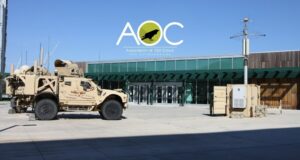
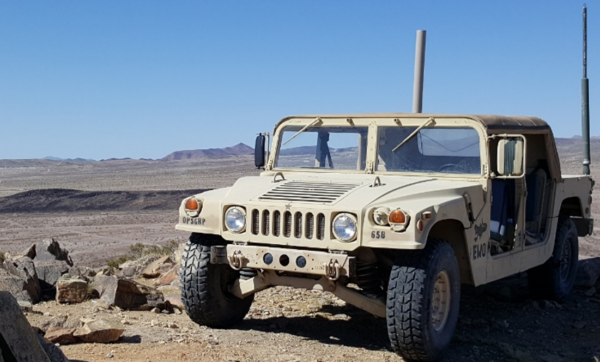
One day, one of my Soldiers suggested we repurpose one of our Dukes as a jammer. The bad tactics, techniques, and procedures (TTP) that the units had developed wouldn’t work against a Duke. We reached out to the Army’s EW Office, the Program Manager Electromagnetic Warfare & Cyber (PM EW&C), and the vendor, Syracuse Research Corporation (SRC) for some assistance. Soon, we had engineers crawling around one of our OC/T HMMWVs with us installing a Duke and programming it to jam Army radios. We tested the system between rotations with the help of our Spectrum Management team with extremely encouraging results. The next step was to get our command to let us use it.
Our first operational test came against an Armored BCT. After days of being refused, our commander finally let us take the Duke truck out for a mission. As soon as we were told those magical words – “buzzer on” – I flipped the Duke to run and sat back to watch the tank battle all around me.
About an hour into the jamming mission, a training unit HMMWV appeared on a ledge just below my hilltop. I walked down to the vehicle to find a truck full of cavalry scouts that had their radios repurposed to serve as a retransmission site. I spoke with their team lead, a young Staff Sergeant.
I asked, “What are y’all up to Sergeant?”
“We got sent out to be a RETRANS for our Battalion, sir. The TOC couldn’t talk to them.” I asked him if it was working, and he replied with a sheepish grin and a “no” headshake.
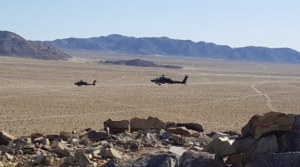
I left them and walked back up the hill to my truck until the battle was over. During that time, I watched an AH-64 Air Weapons Team (AWT) from the unit aviation element pull up beside my hill. The Duke kept on rolling. The AWT sat beside me. And sat. And sat.
Eventually, they headed back to the Forward Arming and Refueling Point not having expended any ordnance. I always imagined the two air crews talking to each other and asking if they could hear anyone else talking. Since they were right beside my jammer, no one was able to tell them where to go or what to engage, so eventually they just went home. As the battle wrapped up, I turned the Duke off and walked back down to the RETRANS team.
I told the Staff Sergeant, “Check your radios, are they working now?”
“Yes, sir, they are,” he replied before giving me a suspicious look. “Wait, what did you do?” he asked.
And just like that, our first jamming mission was a resounding success. Four Cavalry Scouts got to learn what jamming was, an AWT wasted a bunch of fuel, and an entire Tank Battalion couldn’t communicate.
We didn’t always just jam the training unit. At times, we replicated the training unit having access to Joint EW aircraft to support their operations, so we used the Duke to jam the OPFOR too. One rotation with a Stryker BCT, we were asked to jam OPFOR “insurgents” as the BCT attacked to seize a city. I set the Duke truck up on a hilltop overlooking the town. I also brought along a Versatile Radio Observation and Direction (VROD) system to listen to insurgent activity since they were using simple, unencrypted commercial push-to-talk (PTT) radios.
The “insurgents” had various observations posts (OP) on the hilltops around the town that were regularly reporting to their Troop Commander in the town. I set up, tuned the VROD to their frequency, and waited. The Commander called out for a report from the ops. As soon as he was done speaking, I turned on the Duke. Once the OPs were done reporting, I turned the Duke off. The Commander told the OPs to report again because he couldn’t hear them. I turned the Duke on again when the Commander finished speaking. Off again when the OPs finished.
The Commander asked for the report a third time. Again, I turned the Duke on. This time, when I turned off the Duke, the Commander had given up trying to get the report. His OPs were attempting to tell him the attack was coming but thanks to my jamming, the message wasn’t getting through. The unit took the town with considerably less effort and casualties compared to normal rotations. All thanks to some timely jamming.
Effectiveness of EW is extremely difficult to measure. Not everyone can walk up to their adversary and ask if their radio is working.
EW does not have to be complicated to have an outsized effect on the modern battlefield. Disrupting an adversary’s communication opens windows of advantage that can turn the tide of battle. Integration with operations is the key to success. Jamming is an enabler of maneuver. Just as that tank battalion, the AWT, and the “insurgents” found out, it’s difficult to fight when you can’t communicate.
We as EW professionals too often try to look for exquisite or niche solutions to our targets when the simplest and most basic EW tactics are often more than effective. Don’t overthink it – just keep on jamming.