AOC Europe 2026 Puts EW Innovation and Ukraine Lessons at Center Stage




By JED and AOC staff
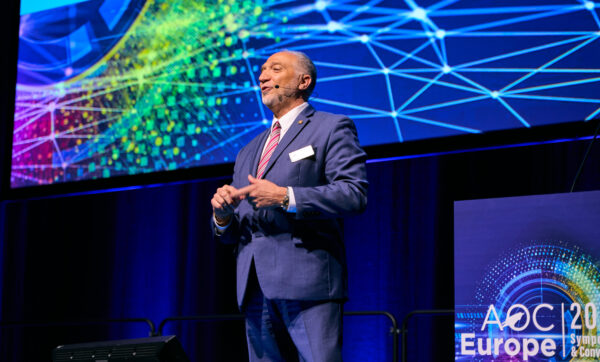
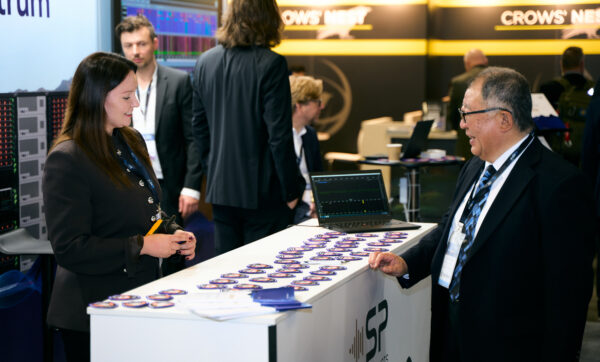
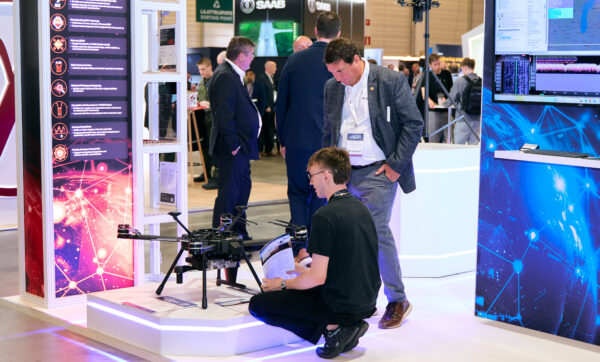
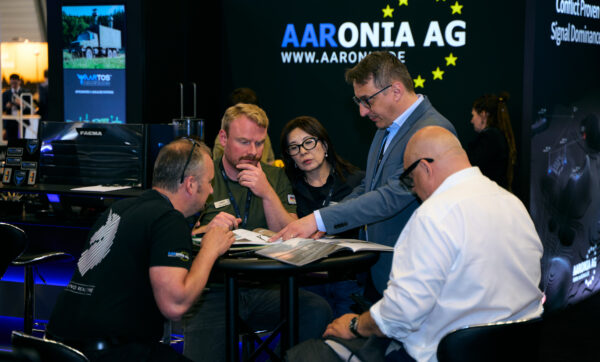
AOC gathered in Helsinki, Finland, 19-21 May 2026 for AOC Europe 2026, bringing together electromagnetic warfare professionals, military leaders, and industry representatives from across the continent and beyond. The symposium spanned three days of keynotes and sessions, with the Russo-Ukrainian War serving as a throughline, and the convention’s Expo Hall showcased EW systems, technologies, and services, providing attendees with direct access to industry’s latest defence capabilities and solutions.
PLATH Intelligence Day Sets the Tone
The event opened with PLATH Intelligence Day, sponsored by PLATH and focused on cyber electromagnetic activity (CEMA), software-defined defence, and the evolving drone landscape. PLATH CEO Gregor Zowiercha framed the day’s scope broadly, encompassing both traditional EW and SIGINT.
Colonel Matthias Puschnig of Austria’s Federal Ministry of Defence, Special Staff Ukraine, delivered the opening keynote, offering a frank assessment of the Russo-Ukrainian War as “multidimensional trench warfare” defined by stalemate across ground, air, maritime, and cyber domains. “No military aircraft is crossing the front line anymore,” he said. “There is no major vessel on the Black Sea anymore. Even in cyberspace, there’s something like a stalemate.” Despite rapid drone and counter-drone innovation cycles – with a “breakthrough” roughly every three months – none has broken the positional character of the war. The single most consequential development, in his view, has been Ukraine’s development of a software architecture that enables rapid integration and fielding of new command and control capabilities.
Mario Behn, Germany’s Defence Technology Attaché in Ukraine, reinforced that theme, arguing that software architecture is the connective tissue binding sensors, C2 systems, and effectors together. He identified CEMA and mobility as the two most operationally relevant factors in protecting critical infrastructure at the front.
Finnish General Calls for Cultural Change in EMS
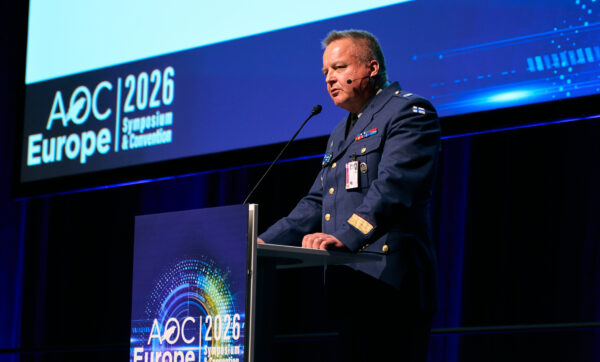
Wednesday’s opening keynote came from Brigadier General Juha-Matti Ylitalo, Deputy Chief of the Finnish Defence Forces Logistics Command and Chief Engineer of the Finnish Defence Forces, who offered a wide-ranging perspective on electromagnetic spectrum operations from a Nordic vantage point.
Ylitalo described Finland’s long-horizon approach to capability planning – currently looking toward the end of the 2040s – while acknowledging the tension between that long-term structure and the demand for rapid innovation. He questioned whether NATO Standardization Agreements (STANAGs) are keeping pace with the current operational and technological tempo, noting that Finland is working to implement roughly 100 STANAGs per year since joining the alliance. “What we need across all the organizations is a change of culture,” he said. “We need rapid development, but still we need structures.”
Ylitalo also highlighted an ambitious Finnish effort to build a joint training environment capable of integrating live, virtual, and constructive elements across all services – drawing on an existing model used for fighter pilot training – and called for a similar approach to electromagnetic operations training, including real-time, multi-service electronic order of battle situational awareness.
He closed with a call for cultural adaptation at every level of military organization: “To survive and to be effective on a battlefield packed with full spectrum radiation emission and counter capabilities, you need cultural change, you need awareness of new technologies and capabilities … You need awareness that you are observed all the time; you can’t hide.”
The keynote opened a full day of programming that explored electromagnetic operations in the Nordic region, space domain operations, and NATO EW training challenges.
Education, Community, and Connection Beyond the Main Stage
AOC Europe 2026 offered meaningful opportunities for professional development and relationship-building throughout the week, extending well beyond the formal sessions.
The event kicked off on 18 May with two full-day Pre-Convention Courses, each offering focused professional development immediately ahead of the main program. The first, Aspiration Versus Reality: Russia’s Electronic Warfare Posture – Past, Present, and Future, presented by Dr. Thomas Withington, provided an in-depth examination of Russia’s EW capabilities and trajectory. The second, Weapon System Teardown – A View from Uncle Luke’s Garage, presented by Luke Cabot, offered a more hands-on technical perspective on EW systems.
On Wednesday morning, the AOC’s Empowering Women in Electromagnetic Warfare (EW in EW) Committee hosted its Power Up Morning Meetup, drawing participants from multiple countries and continents across a wide range of roles and experience levels. The gathering fostered discussion on professional development, chapter-building best practices, and practical strategies for advancing careers in the EW community.
That evening, the City of Helsinki welcomed hundreds of symposium guests to a reception at City Hall, one of the Finnish capital’s most elegant settings. Over wine and hors d’oeuvres, VIP speakers, attendees, and exhibitors mixed freely in an atmosphere that extended the day’s professional conversations into something more personal. A city official thanked AOC for bringing the conference to Helsinki and warmly invited AOC to return.
Ukraine EW Lessons Anchor Final Day
The final day opened with a session on electromagnetic warfare lessons from the Russo-Ukrainian War, drawing on perspectives from alliance observers and a Ukrainian EW commander with direct front-line experience.
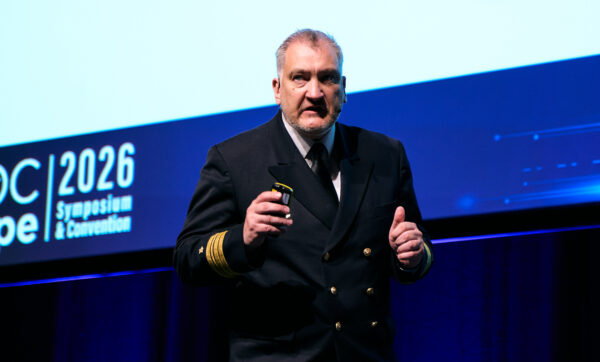
Commander Malte von Spreckelsen of Germany’s Cyber and Information Domain Service (CIR) updated attendees on the Ukraine Defence Contact Group’s EW Coalition, which Germany co-chairs, noting the coalition is seeking up to €3.8 billion this year to address Ukraine’s EW requirements.
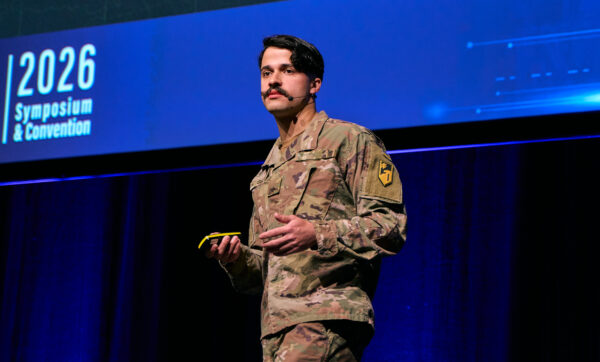
Two professors from the U.S. Army War College – CDR Michael Posey, USN, and Lt Col David Zesinger, USSF – outlined alliance lessons for future fights, focusing on Ukrainian use of EW to disrupt Russian decision cycles. Among their examples: Ukrainian forces exploited Russia’s unauthorized reliance on Starlink by standing up a false service, collecting registration and location data from subscribing Russian units and using it for targeting.
The session’s standout was a first-hand account from Junior Lieutenant Pavlo Utiuzh, an EW company commander in the 1st Corps Azov of the Ukrainian National Guard, operating in some of the conflict’s most intense sectors. He opened with a striking statistic: 58% of his unit’s losses are directly attributable to strike drones, with most of the remaining casualties also drone-related. He noted that Russia’s specialized drone unit, Rubicon, uses fiber-optic drones for roughly 20% of its strikes, leaving the remaining 80% vulnerable to RF detection and countermeasures.
Utiuzh walked through five core challenges – threat diversity, complex C2 structures, electromagnetic fratricide risk, sub-5-minute decision timelines, and operator shortages – before describing the solutions his unit has developed in response.
“Modern electronic warfare units operate on hyper dynamic battlefields,” Utiuzh concluded. “Success no longer depends just on the power of your jammers, but on the ability to process massive amounts of data and make effective decisions in seconds. Looking ahead, our highest priority must be the automation of threat detection and countermeasure selection, real time situational awareness, including the integration of artificial intelligence.”
The morning session gave way to a robust rest of the day, which included discussions on achieving success in EMS operations, PNT/GNSS denial and protection, AI/ML and cognitive EW, the expanding role of autonomous platforms, and a closing session examining what a Ukrainian electromagnetic victory might ultimately look like.
Save the Date: AOC Europe 2027
AOC Europe 2027 will be held 4-6 May in Lisbon, Portugal, with Pre-Convention Courses on 3 May. Look out for more details soon at aoceurope.org.