
APS More Critical Than Ever for Protecting Armor Against Drones


By Andrew White
Active Protection Systems (APS) were front and center at the Eurosatory exhibition in Paris, as armed forces seek to ensure expensive armored vehicles remain as survivable as possible on the modern battlefield. Although market leaders Elbit Systems and Rafael Advanced Defense Systems were restricted by the French government in what they could promote at the show, European providers were able to showcase their latest capabilities.
Rheinmetall and Indra signed an agreement on at Eurosatory which outlined plans to integrate Indra’s NEMUS AESA radar into Rheinmetall’s StrikeShield APS. StrikeShield is currently under contract with the Hungarian Defence Force for its new inventory of Lynx infantry fighting vehicles.
To date, StrikeShield has been focused on “close in” protection against incoming missile threats. However, Rheinmetall’s Martin Debo, Head of Product Unit APS, explained how NEMUS will provide a longer range detection capability for StrikeShield. “We have tested NEMUS several times and created the interface when needed. This partnership combines our technological expertise, allowing us to establish a strong basis for future system enhancements and maximum survivability in the context of rapidly changing threat scenarios,” he said. “We will finish function tests and the overall chain by end of the year and then its ready to qualify.”
According to Indra, the NEMUS radar is capable of detecting slow-moving drones at speeds as low as 10m/sec, as well as simultaneous tracking of “high‑velocity threats exceeding 2,000 m/sec, including kinetic‑energy projectiles. This unique capability allows a single system to address a broad range of missions, being integrated into C‑UAS systems; short-range air defense (SHORAD); intelligence, surveillance, target acquisition and reconnaissance (ISTAR) solutions; and APS applications for armored vehicles and battle tanks, a company statement read.
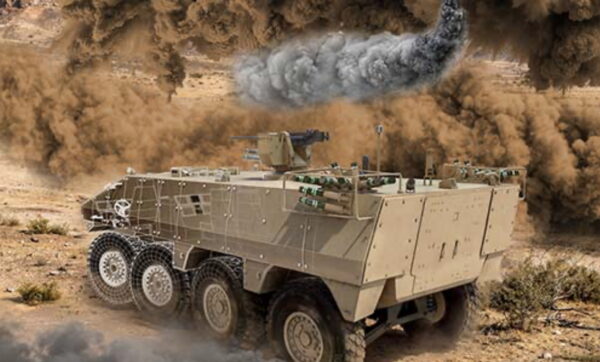
Elsewhere at Eurosatory, Lacroix discussed its latest upgrade for the S-KAPS protection solution, which has been extended to protect ground vehicles from weaponized drones operating overhead. S-KAPS was first launched in 2016 to protect vehicles from laser-guided munitions fired from the flanks. The latest capability injection is a collaboration between Lacroix, Bertin Technologies, and MC2 Technologies and sees the optional integration of the HADDES RF drone detection sensor and PeriSight Top Attack IR surveillance system into S-KAPS. The upgrade also includes an acoustic detection unit from Metravib. “By combining multi-sensor analysis and drone interception, this new technological component of the S-KAPS system provides armoured vehicles with a comprehensive and modular protective bubble, tailored to the asymmetric threats of modern operational theatres,” a company statement read.
A company official confirmed the upgrade was the result of lessons learned from the Russia-Ukraine War and went onto describe how the solution could detect and assess a threat before creating a “tunnel of multi-band countermeasure obscurants” for a vehicle to avoid it. Previously, countermeasures had only protected the side of the vehicle facing the threat.
The upgrade means S-KAPS is now equipped to disrupt drones fitted with laser designators as well as armed UAVs, first person view (FPV), and loitering munitions operating EO/IR cameras.
The solution is being promoted as a more cost effective capability when compared to more expensive and heavier APS solutions, such as Iron Fist and Trophy.
The French Army’s Caesar self propelled howitzer is expected to be the first armored vehicle to benefit from the upgraded S-KAPS.