HEL and More from Eurosatory


By Andrew White
Several companies at the Eurosatory exhibition in Paris, France showcased new directed energy weapon (DEW) solutions designed to support layered defense against uncrewed aerial vehicles (UAVs).
Singapore’s, ST Engineering showed its Counter-Drone Laser Effector (CDLE) for the first time outside of Singapore. The CDLE is a 3-kW system designed to neutralize “Class 1 Micro-UAVs” at ranges up to 1 km, a company official said. “With the rapid proliferation of small drones, security forces require a counter-drone solution that delivers fast, precise and controlled neutralization,” he said, adding, the CDLE includes automated precision tracking and “fast dwell times of less than 10 seconds at 1km and 5 seconds at 0.5km. The CDLE also integrates a sighting capability for target detection at ranges up to 1.5km.
Measuring 1.4 x 1 x 1.8 meters and with an all up weight of less than 500 kg, CDLE can be integrated on board a 4×4 pickup truck or deployed as a fixed-site solution, the ST Engineering official explained, with integrated battery providing 10 hours of surveillance and 6 minutes of lazing.
Target detection and tracking of threats up to a range of 1km in both day and night conditions is enabled by a mid-wave IR zoom camera integrated into the CDLE. A visible zoom camera provides end users with situational awareness, as well as target detection and tracking, while a near-IR illuminator can be used to target a threat in low-light conditions. A visible/near-IR camera also ensures the end user has “eyes on” the threat during engagement.
ST Engineering confirmed the CDLE can be integrated into existing counter-drone sensors, capable of receiving target detection and cueing information via Ethernet connection for rapid response. This includes an agnostic approach to radar integration, although the company official was unable to confirm which solutions are being considered by ST Engineering.
The solution also includes an onboard inertial navigation system to orientate in real-time for “precise target alignment”, the company official added. The HEL is water-cooled and uses ST Engineering’s thermal energy storage unit. The CDLE also includes a climate-controlled cabin, which ensures the system can be operated in temperatures ranging between 0 and 50-degrees Celsius. The cabin ensures “optimal performance” in terms of the high energy laser source, thermal and electrical energy storage as well as system electronics.
The company official also discussed the CDLE’s applications beyond Micro-UAVs. “Through precision beam control and accurate tracking, the CDLE can concentrate energy on flight- and mission-critical components of hostile drones – including propellers, motors, flight control surfaces and payload sections. This enables the system to address a broad range of hostile targets ranging from small commercial quadcopters and improvised UAVs to larger threats such as Shahed-type drones.”
Elsewhere at Europsatory, Rohde & Schwarz confirmed it is in the process of integrating a 5-kW HEL into its THORIS counter-drone solution. A company spokesperson confirmed a Trumpf HEL is being used to support ongoing laboratory tests ahead of on-the-move targets.
Rohde & Schwarz also displayed an artist’s impression of a generic 4×4 vehicle equipped with the THORIS counter-drone suite and a Trumpf HEL unit. The spokesperson said the THORIS Laser Combat System – a “platform and effector agnostic” solution – will be ready in 2028, supported by the THORIS sensor suite.
Using its expertise in industrial laser technology, Trumpf’s HEL has a maximum range of 2km, although further details remain undisclosed as JED went to press. The unit itself was not exhibited at Eurosatory.
“We are testing the gimbal right now alongside the THORIS C2 software, as well as a third-party radar and electro-optics,” the spokesperson explained, before confirming additional capabilities will be integrated at a later date.
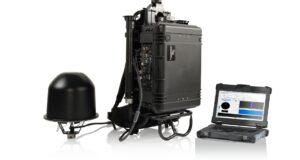
THORIS, essentially a rebranding of Rohde & Schwarz’s ARDRONIS family of counter-drone systems, will also feature the company’s Multi-Band Jammer (MBJ), designed to “disrupt individual or swarms of jam-resistant drones, even in contested and congested of operating environments”, according to company literature. “Covering 400MHz-6GHz, the MBJ features a wideband amplifier, six signal generators, directional or omni-directional antenna and graphic user interface (GUI). Collectively, signal generators are capable of generating 250W in output power against a single target. Alternatively, they can operate individually targeting up to six different radio frequencies with 50W in output power,” the description explained.