

By Richard Scott and John Knowles
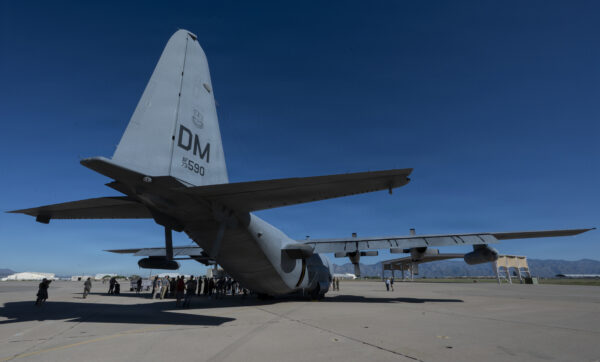
The US Air Force formally retired the EC-130H Compass Call electromagnetic warfare aircraft at a ceremony at Davis-Monthan Air Force Base, Arizona, on September 18.
Aircraft 73-1590 performed a last ground taxi during the event before being transferred from the 55th Electronic Combat Group to the 309th Aerospace Maintenance and Regeneration Group. The aircraft had completed a final flight from Davis-Monthan AFB on September 2.
Read more about AOC’s participation at the retirement ceremony for the EC-130H Compass Call.
Entering operational service with the USAF in 1983, the EC-130H Compass Call was a heavily modified variant of the C-130 Hercules airlifter equipped to jam enemy command and control communications, radars, and navigation systems in support of US and coalition forces. A total of 14 aircraft were delivered to EC-130H standard, with L3Harris acting as the aircraft prime and BAE Systems supplying the Compass Call EW mission payload for the majority of its operational life.
Over its more than four decades of service, the EC-130H provided critical support jamming in a number of operational theaters, including Panama (Operation Just Cause), Iraq (Operation Desert Storm and Operation Iraqi Freedom), Haiti (Operation Uphold Democracy), Kosovo (Operation Allied Force), Afghanistan (Operation Enduring Freedom), and Libya (Operation Odyssey Dawn). Its final operational deployment was to the Persian Gulf earlier this year during the early stages of Operation Epic Fury.

The EC-130H Compass Call was originally fielded as a high-power communications jammer to counter the C2 networks of enemy integrated air defense systems – part of a larger airborne electronic attack mission that included the EF-111 Raven, the EA-6B Prowler and the EA-18G Growler. In order to remain current against constantly evolving communications and radar systems, the EC-130H underwent regular upgrades to its baseline mission system, as well as receiving Quick Reaction Capabilities and new jamming systems, such as the Special Purpose Emitter Array (SPEAR). During the Global War on Terror, the Air Force adapted the EC-130H mission and capabilities to provide communications jamming and counter-RCIED support for US and coalition ground forces and special operations forces.
The Compass Call mission has now been migrated to the EA-37B aircraft, which is based on a modified Gulfstream G550 business jet airframe. Compared to its predecessor, the EA-37B rationalizes crew requirements (from 13 down to nine) while increasing operating altitude, range, speed, cost efficiency and standoff distances.
The initial EA-37B configuration – known as Baseline 3 – re-hosts the existing EC-130H Baseline 2 Prime Mission Equipment and antenna arrays in the modified G550 jet. The first five EA-37Bs have been delivered to Baseline 3 standard.
The follow-on Baseline 4, which transitions the software baseline to an agile software framework and implements System-Wide Open Reconfigurable Dynamic Architecture (SWORD-A) to enable rapid integration of new capabilities, will be embodied in subsequent EA-37B airframes. The USAF’s FY2027 budget request laid out a plan to increase the planned EA-37B fleet from 12 to 15 aircraft; in late April, Air Force leaders told Congress they now intend to procure 22 EA-37Bs.
BAE Systems (mission system payload) and L3Harris (airframe integration) delivered the first EA-37B for developmental testing in 2023. Air Combat Command received the first two aircraft in 2024, with the 55th Electronic Combat Group starting initial training sorties in 2025. The first operational deployment of EA-37B Compass Call aircraft was recorded earlier this year in support of Operation Epic Fury.