

By Andrew White
The US Navy’s Silent Swarm experimentation exercise, conducted July 13-24, saw REGENT Defense’s “Squire” Seaglider flying with electronic warfare (EW) payloads for the first time, company officials told JED at the Global SOF Indo-Pacific Irregular Warfare Symposium in Honolulu.
Led by Naval Surface Warfare Center-Crane, the Silent Swarm event was conducted around the Alpena Combat Readiness Training Center and Lake Huron, Mich., with heavy focus on electromagnetic spectrum operations (EMSO). According to US Navy literature, it featured a total of 26 industry participants who demonstrated a series of multi-domain uncrewed solutions.
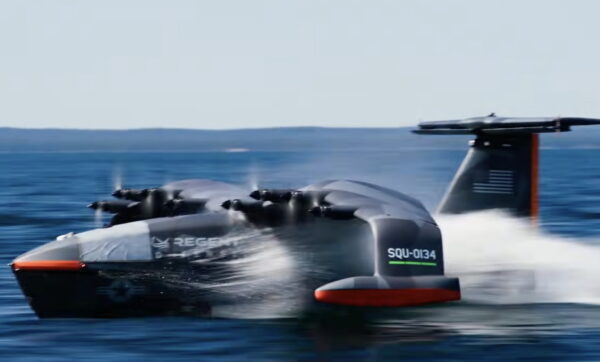
Regent’s Unmanned Surface and Aerial Vehicle (USA-V), which is currently under contract with the US Marine Corps as part of an Other Transactional Agreement (OTA), flew single to multiple times during 13 out of 14 days of the exercise. The Squire USA-V uses “wing-in-ground effect” to operate just above the surface and “below line-of-sight radar”. It has a maximum speed of 70 kts, an operational range of 100 nmi and is designed to support ISR, logistics, search and rescue and anti-submarine warfare mission sets.
According to a company statement, Silent Swarm brought together “small, multi-domain uncrewed systems” to demonstrate EW payloads in real-world conditions. Squire carried various electronic attack and ESM payloads over 13 days of varying mission types, according to the company
A company official confirmed the USA-V carried a total of five, undisclosed EW and ISR payloads which supported both offensive and defensive EW mission profiles. The platform has a 50-lb payload capacity. The vehicle was also equipped with DECPT’s multi-spectral camouflage “wrap,” used to manage the signature of the platform on and above the water.
Regent’s official said the USA-V operated in inclement weather conditions and rough water, adding that it was the first time the platform had flown with EW payloads. “Silent Swarm was focused on EW, but we also have an ongoing effort with an undisclosed Navy customer to add sensors to achieve effects in the maritime environment,” he added.
The exercise also saw the Squire USA-V integrating with “government command and control” networks. It also saw the USA-V cueing Tactical Assault Kits (TAKs) as part of a crewed-uncrewed teaming concept.